





Tubes, Vials, Plates, Tips, Racks and Cleanroom Supplies
This collection covers the disposables and holders a working laboratory goes through continuously: conical centrifuge tubes, microcentrifuge and screw cap tubes, cryogenic vials, deep well and PCR plates, pipettes and tips, Dewar flasks, and the racks, caddies and dispensers that keep all of it in order. Brands include NEST Scientific, Heathrow Scientific, Oxford, Dynarex, Benchmark Scientific, Scilogex, Jeio Tech and OptiWell.
Two choices in this category get made casually and then cause problems months later. The first is sterility and packaging: sterile racked consumables cost more per unit than bulk bagged, and buying bulk for work that requires sterility means the saving is spent again on a contamination event. The second is cryogenic vial thread type, which determines whether a vial can go into liquid phase nitrogen at all.
Both are covered below, along with the tube and plate formats that make up the bulk of what a lab orders.
→ Part of Laboratory. Also see Pipettes & Tips, Blood Collection Supply, Lab Storage & Organization and Cryogenic Storage.
Conical Centrifuge Tubes and Sample Tubes
Conical tubes at 15 mL and 50 mL are the workhorses of cell culture and general sample handling, and the specification that matters most after volume is whether they arrive sterile.
Heathrow Scientific supplies 15 mL conical tubes and 50 mL sterile conical tubes, with black-capped sterile versions in 15 mL and 50 mL. For larger volumes, bagged centrifuge tubes run 175 mL, 225 mL, 250 mL with rack and 500 mL.
Microcentrifuge and screw cap tubes
Screw caps seal more reliably than snap caps under pressure and temperature change, which matters for long-term storage and for anything that will be heated or frozen. Snap caps can pop during heating or in a freezer, and a tube that has opened in a box is usually a lost sample. See 0.5 mL screw cap microtubes in cases of 1000 and DuoClick 17x100 mm screw cap culture tubes.
Specialty tubes
FlowTubes for flow cytometry in bulk packs, 12x60 mm polystyrene test tubes, Oxford OptiMate PCR and qPCR strip tubes and Dynarex disposable base molds for histology embedding.
Cryogenic Vials: Internal or External Thread?
An internally threaded cryogenic vial has the cap thread inside the tube, so the sealing surface is protected and liquid nitrogen cannot enter the thread. An externally threaded vial has the thread on the outside, which is easier to handle but leaves a path for liquid to enter.
This is not a preference. Vials stored in liquid phase nitrogen can take liquid into the thread, and when the vial is removed and warms, that trapped liquid expands violently. Vials can rupture. For liquid phase storage, internally threaded vials with an O-ring seal are the appropriate specification, and many facilities restrict liquid phase storage to sealed secondary containment for exactly this reason. Vapour phase storage avoids the problem entirely, which is why it has become the more common approach.
Options: 1 mL skirted cryogenic vials, Heathrow 2 mL sterile cryogenic vials in packs of 500 and Dynarex cryogenic tubes with graduated markings. Skirted vials stand upright on a bench, which sounds trivial until you are working one-handed at a dewar.
Deep Well Plates and Plate Formats
Deep well plates differ in well geometry as well as volume, and the geometry affects mixing, recovery and how well an automated tip can reach the bottom.
- Round well, V bottom: the OptiWell 0.36 mL 96-round V bottom. Round wells with a V base concentrate small residual volumes at a single point, which improves recovery.
- Square well, U bottom: the 1.0 mL 96-square U bottom. Square wells hold more volume in the same footprint and the U base is gentler for cell-containing samples.
- Square well, V bottom: the 1.0 mL 96-square V bottom, combining square-well capacity with V-bottom recovery.
Sterile 8-position V bottom tip combs are stocked for magnetic bead-based extraction workflows.
Pipettes, Tips and Serological Pipettes
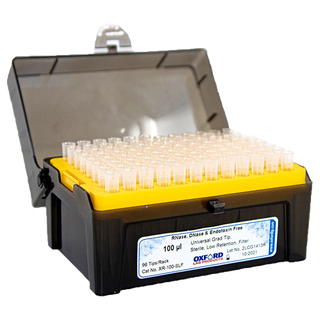
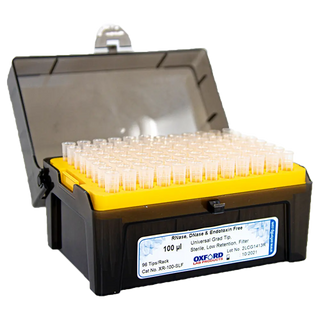
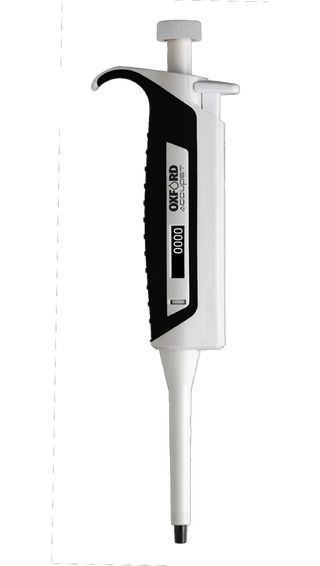
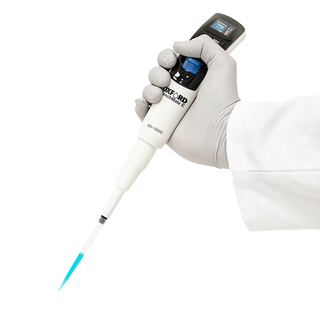
The full liquid handling range sits within this collection: single and multichannel pipettes, electronic pipettes and controllers, universal and filtered low retention tips, and serological pipettes from 1 to 50 mL.
Two tip properties do most of the work. Low retention tips reduce the liquid film clinging to the inner wall, which matters at small volumes and with detergent-containing or protein-rich solutions. Filtered tips stop aerosol reaching the pipette barrel, which is standard practice for PCR setup where carryover produces false results.
→ The full range, including channel count guidance, tip selection and serological pipette sizing, is covered in Pipettes & Tips.
Dewar Flasks for Cryogenic Handling
A Dewar flask holds liquid nitrogen or dry ice at the bench for short-term working use, as opposed to bulk storage in a cryogenic tank. Case material and mouth geometry determine what it suits.
Scilogex offers stainless steel cased flasks with lid clips and handle in 1 to 4.5 L capacities, an enamelled cased version in the same range, an all stainless steel flask from 0.5 to 6 L, and a wide-top shallow flask from 0.17 to 1.9 L. The wide-top shallow design exists for dipping and retrieving items rather than pouring, which is the more common bench operation when snap-freezing samples.
Cryogenic handling requires appropriate PPE. See cryo gloves, aprons and gaiters, and Cryogenic Storage for bulk storage.
Racks, Caddies and Bench Organisation
Racks are not accessories in a lab that runs samples. A tube that tips over is a lost sample, and a rack that fits the freezer box grid is what keeps an archive findable two years later.
- Conical tube racks: a conical tube rack, a rack holder, a 2x4 freezer box rack and a 50 mL freezer rack at 7x20 inches.
- Hood-mounted racks: tube and vial rack holders in 8 inch and 9.5 inch widths, which get racks off the work surface inside a hood where floor space is the scarcest resource in the lab.
- Tip organisation: horizontal tip organizers, a stable stack tip box shelf and a tip receptacle.
- Petri dish handling: a petri dish dispenser, a 4-slot dispenser, a 6-pocket caddy and a petri film caddy.
- Sample stability: a sample tube strip tray stabilizer, plus Dynarex tube racks and Medivena One Care tube holders.
Cleanroom Supplies and Filtration
For controlled environments: cleanroom wipe dispensers, lint-free wipe holders, sign sleeves, liquid-resistant PETG sign sleeves, PETG logbook sleeves and a cubic box stand. Documentation sleeves matter more in a cleanroom than elsewhere, because paper sheds particles and an unprotected logbook is a contamination source sitting on the bench.
Filtration equipment: the Jeio Tech EFS-33 extraction filter system and the FSC-280 filter storage cabinet with pre-filter. Also stocked: the Scilogex reaction block series for round bottom flasks.
Frequently Asked Questions
When do I need sterile consumables rather than bulk?
Whenever contamination would compromise the work: cell culture, molecular biology, clinical sample handling and anything where a downstream result depends on the sample being what you think it is. Sterile racked consumables cost more per unit than bulk bagged, but the saving on bulk is spent again the first time a contamination event costs you an experiment. For non-critical work such as buffer preparation and general bench use, bulk is entirely appropriate.
What is the difference between internally and externally threaded cryogenic vials?
An internally threaded vial has the cap thread inside the tube, protecting the sealing surface and preventing liquid nitrogen entering the thread. An externally threaded vial has the thread outside, which is easier to handle but leaves a path for liquid to enter. For liquid phase nitrogen storage, internally threaded vials with an O-ring are the appropriate specification, because liquid trapped in a thread expands violently as the vial warms and vials can rupture. Vapour phase storage avoids the issue.
Should I use screw cap or snap cap microcentrifuge tubes?
Screw caps seal more reliably under pressure and temperature change, so they suit long-term storage and anything that will be heated or frozen. Snap caps can pop open during heating or in a freezer, and a tube that has opened inside a box is usually a lost sample plus a contamination problem for its neighbours. Snap caps are faster to open and close, which suits high-throughput routine work at ambient temperature.
What is the difference between round and square deep well plates?
Square wells hold more volume in the same plate footprint, which is why they dominate deep well formats. Round wells mix more evenly and are gentler on cells. Base geometry is a separate choice: a V bottom concentrates small residual volumes at a single point for better recovery, while a U bottom is gentler on cell pellets. Match well shape and base to whether recovery or cell integrity matters more.
What size conical tube should I use?
15 mL and 50 mL cover most cell culture and general sample handling. Above that, bagged centrifuge tubes run to 175, 225, 250 and 500 mL for larger preparations. Check rotor compatibility before ordering a larger size: a 250 mL tube needs a rotor that accepts it, and a tube that does not fit your centrifuge is an expensive storage container.
What is a Dewar flask used for?
Holding liquid nitrogen or dry ice at the bench for short-term working use, as distinct from bulk storage in a cryogenic tank. Choose case material and mouth geometry by task: a wide-top shallow flask suits dipping and retrieving items, which is the usual operation when snap-freezing samples, while a taller narrow flask holds volume with less evaporation. Cryogenic PPE is required regardless of flask type.
Do I need racks that match my freezer boxes?
If you archive samples, yes. Racks sized to the freezer box grid are what make an archive navigable two years later, when the person who filed the samples has moved on. A mismatched rack means samples get stored loose, which is how boxes get opened and searched, which is how the rest of the box warms up. Freezer racks are stocked in formats such as 2x4 and 7x20 inches.
Why use hood-mounted rack holders?
Because work surface inside a biosafety cabinet or hood is the scarcest space in the lab, and anything sitting on it also disrupts the airflow the cabinet depends on. Mounting racks to the hood wall clears the work surface and keeps tubes within reach. Available in 8 inch and 9.5 inch widths to suit different cabinet interiors.
Why do cleanroom documents need PETG sleeves?
Paper sheds particles, and an unprotected logbook or sign in a controlled environment is a contamination source sitting on the bench. PETG sleeves contain the paper while keeping it readable, and liquid-resistant versions survive the disinfection wipe-downs that would destroy an unprotected document. In a validated cleanroom this is a documented requirement rather than a preference.
Are case quantities cheaper than individual packs?
Per unit, yes, usually substantially. The question is turnover: a case of sterile consumables that sits for two years may pass its expiry before it is used, and sterile packaging has a shelf life. For high-turnover items such as tips and conical tubes, case quantities make sense. For specialist formats used occasionally, smaller packs avoid writing off unused stock.
MediDepot Purchasing Advantages
- Price Match Guarantee: found the same catalogue number for less elsewhere? We will match the verified price.
- Equipment Financing: available when consumables form part of a larger laboratory equipment order.
- Extended Warranty: available on qualifying instruments.
- Military Discount: available for qualifying military medical and research facilities.
- Request a Quote: case quantity pricing, standing consumable orders and format compatibility questions.
Related Buying Guides
- Lab Equipment Supplier Guide: How to Evaluate Vendors
- Laboratory Freezer Size Comparison Guide
- ULT Freezer vs Lab Freezer: Cost of Ownership
- Model Number Comparison Guide
- How to Verify Authorized Medical Equipment Sellers