







Micro, Clinical, Hematocrit and Refrigerated Benchtop Models
Lab centrifuges divide into four working types: mini and microcentrifuges for tubes under 2 mL, clinical centrifuges for 10 to 15 mL blood and specimen tubes, hematocrit centrifuges for capillary tubes at very high speed, and refrigerated models for temperature-sensitive work. MediDepot stocks 26 models from Benchmark Scientific, Heathrow Scientific, Oxford BenchMate and Grafco.
The mistake almost everyone makes when buying their first centrifuge is shopping by RPM. RPM is the number on the front of the machine, but RCF, the actual force applied to your sample in units of gravity, is what your protocol specifies and what determines whether the separation works. RCF depends on rotor radius as well as speed, so two machines running identical RPM can deliver very different results.
The second mistake is buying the machine before checking the rotor. A centrifuge that cannot accept your tube format on day one is not a centrifuge, it is a paperweight with a lid. Write down your top three tube types before you compare anything else.
→ Part of Lab Instruments. Related: Shakers & Mixers, Homogenizers & Sonicators, Consumables & Plasticware, Blood Collection Supply.
Which Type of Centrifuge Does Your Work Need?
Match the centrifuge to your tube format first, then to the RCF your protocols call for. The four categories below cover essentially all benchtop laboratory work.
| Type | Tube Formats | Typical Work | What to Check |
|---|---|---|---|
| Mini centrifuges | 1.5 and 2.0 mL microtubes, PCR strips | Quick spin-downs, condensate collection, bench convenience | Rotor interchange, footprint, whether it needs its own power |
| Microcentrifuges | 1.5 and 2.0 mL microtubes, 0.2 mL strips | Nucleic acid precipitation, protein pelleting, molecular biology | Maximum RCF, rotor capacity, digital control |
| Clinical centrifuges | 10 mL and 15 mL blood and specimen tubes | Serum and plasma separation, urinalysis, routine clinical work | Swing-out vs fixed rotor, tubes per run, daily duty cycle |
| Hematocrit centrifuges | Capillary tubes | Packed cell volume determination | Maximum speed, reader compatibility, tube count |
Mini and Microcentrifuges for Molecular Work
Mini centrifuges handle quick spin-downs at fixed speed; microcentrifuges add speed control and higher RCF for pelleting and precipitation. Most molecular labs end up with both, because a mini centrifuge next to the pipettes saves walking to the bigger machine twenty times a day.
Mini centrifuges
The Benchmark C1012 myFuge 12 and myFuge mini with two rotors are the bench standards. The two-rotor version covers both microtubes and PCR strips without buying a second machine. Digital versions such as the C2205 myFuge 5D and C2212 myFuge 12 Plus add timer and speed control.
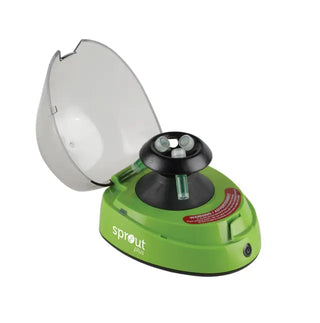
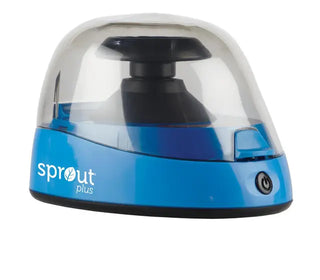
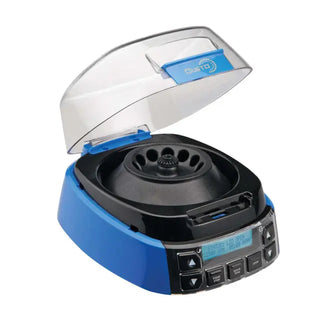
For strip tubes specifically, the Benchmark C2248 StripSpin 12D is purpose-built. Heathrow's Sprout mini centrifuge carries a five year warranty, which is unusual in this price range and worth noting, and the HS10050 Gusto pushes into higher speed territory for a mini.
Microcentrifuges
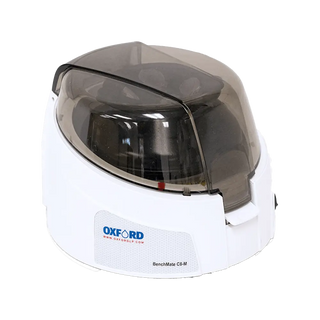
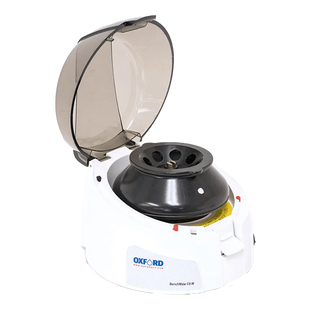
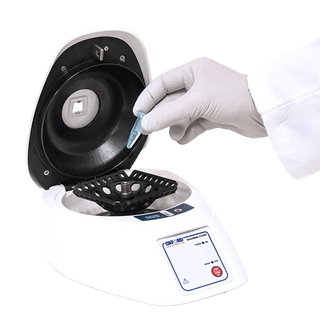
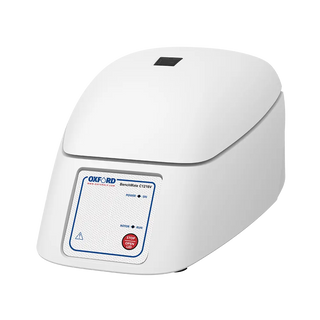
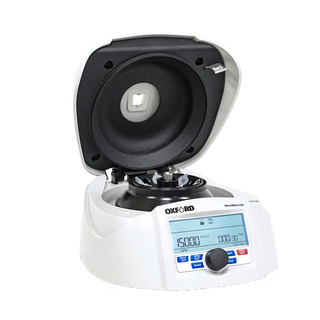
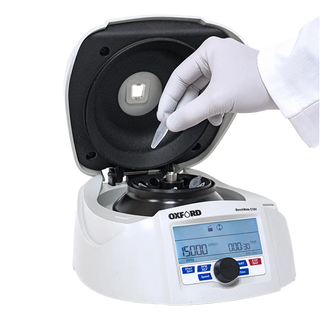
The Benchmark C1612 MC-12 with a 12-place rotor is the entry point. The C2417 MC-24 Touch adds a touchscreen and a combi rotor that takes both microtubes and strips. Oxford's BenchMate line covers the C12V, C1216V and C8-M.
Refrigerated and microplate
If your protocols specify a spin temperature, you need refrigeration and there is no way around it. The Benchmark MC-24R refrigerated high-speed microcentrifuge is the option here, and it matters for RNA work and enzyme preparations where ambient-temperature spinning degrades the sample.
For 96-well plate work the Benchmark C2000 PlateFuge spins plates rather than tubes, which is a different rotor geometry entirely and cannot be improvised with adapters.
Clinical Centrifuges for Blood and Specimen Separation
Clinical centrifuges are specified by rotor style and tube capacity: swing-out rotors produce a flat, clean separation layer, fixed-angle rotors pellet faster and take less headroom. For serum and plasma separation the swing-out geometry generally gives a cleaner interface, which matters when you are drawing off a layer by hand.
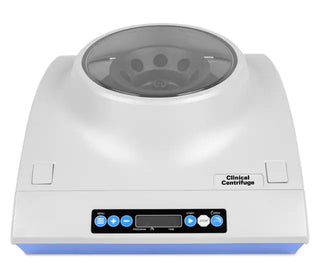
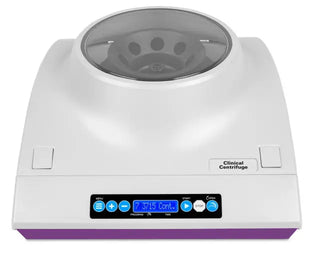
Benchmark's Sprint line covers both. The C5000-6H Sprint 6H uses a 6 x 10 mL swing-out rotor, and the C3303-6HP Sprint 6H Plus extends that platform. On the fixed-rotor side the C5000-8 Sprint 8 and Z207-A Sprint 8 Plus both take 8 x 15 mL. The LC-8 is the general-purpose option in the same tube format.
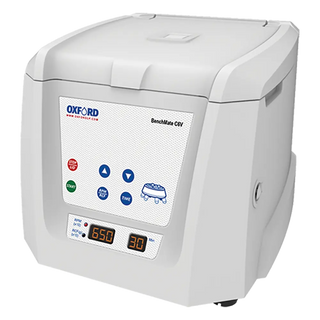
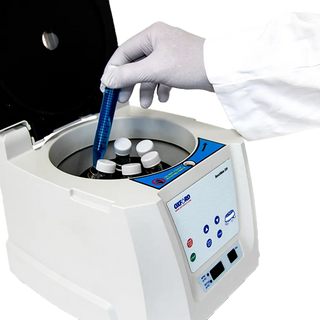
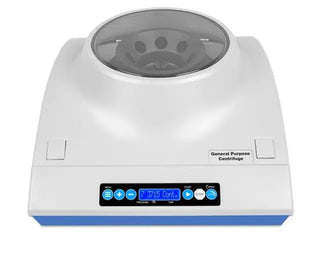
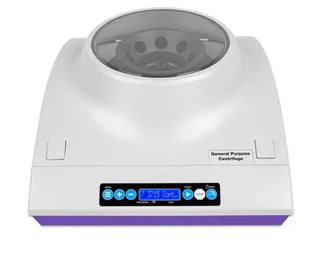
Heathrow offers the clinical benchtop with 8-place removable rotor and a general purpose 8-place model. Oxford's BenchMate C6V covers the clinical range.
Hematocrit
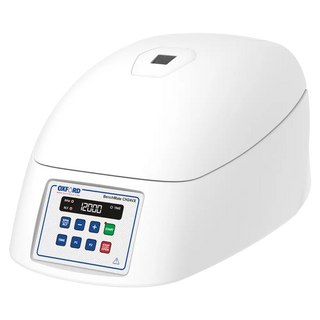
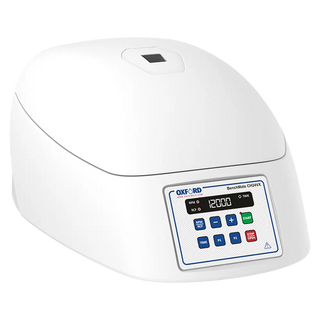
Packed cell volume needs speed that general clinical machines do not reach. The Grafco 410E runs to 12,000 RPM, and Oxford's BenchMate CH24VX is the alternative. Both are capillary tube machines and are not substitutes for a general clinical centrifuge.
Portable and multi-function
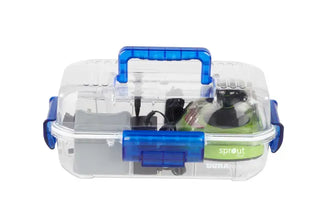
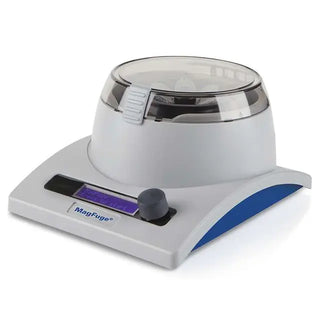
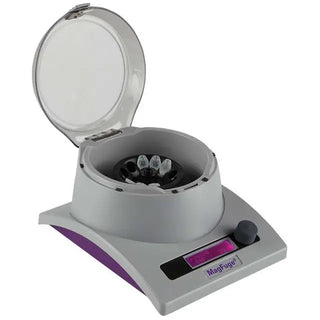
For field collection or mobile clinics, the Heathrow 120568 portable centrifuge kit travels. The MagFuge MFC bundle combines centrifugation with magnetic stirring in one footprint, which is worth considering when bench space is the binding constraint.
Compare Centrifuges by Application
| Model | Type | Rotor / Format | Best Fit |
|---|---|---|---|
| Benchmark myFuge Mini | Mini | Two rotors: microtubes and PCR strips | Bench-side quick spins in a molecular lab |
| Benchmark C2248 StripSpin 12D | Mini, digital | PCR strip tubes | High-frequency PCR setup workflows |
| Benchmark C2417 MC-24 Touch | Microcentrifuge | Combi rotor, tubes and strips | Molecular biology with mixed tube formats |
| Benchmark MC-24R | Refrigerated micro | High-speed microtube rotor | RNA work, enzymes, any protocol specifying 4°C |
| Benchmark C2000 PlateFuge | Microplate | 96-well plates | Plate-based assays and ELISA workflows |
| Benchmark Sprint 6H | Clinical | 6 x 10 mL swing-out | Serum and plasma separation with clean interface |
| Benchmark Sprint 8 | Clinical | 8 x 15 mL fixed angle | Higher throughput routine clinical spinning |
| Grafco 410E | Hematocrit | Capillary tubes, 12,000 RPM | Packed cell volume determination |
| Heathrow 120568 Portable Kit | Portable | Field kit configuration | Mobile clinics, field collection, remote sites |
| Heathrow MagFuge MFC | Multi-function | Centrifuge plus magnetic stirrer | Small labs where bench space is the constraint |
Frequently Asked Questions
What is the difference between RPM and RCF, and which matters?
RPM is how fast the rotor spins. RCF, relative centrifugal force expressed in units of gravity, is the force actually applied to your sample and is what protocols specify. RCF depends on rotor radius as well as speed, so the same RPM on two different rotors produces different RCF. Always specify against the RCF your protocol requires, using the rotor you will actually use. RPM alone tells you very little.
Should I choose a swing-out or fixed-angle rotor?
Swing-out rotors let the tubes rotate to horizontal during the spin, so the pellet forms at the true bottom of the tube and separation layers sit flat. That gives a cleaner interface when you are drawing off serum or plasma by hand. Fixed-angle rotors hold the tubes at an angle, pellet faster and take less vertical clearance, and are the standard choice for microtube work and general pelleting.
Do I need a refrigerated centrifuge?
If any of your protocols specify a spin temperature, for example 4°C, then yes and there is no substitute. Extended spins and back-to-back cycles also generate real heat inside the chamber, which matters for RNA, enzymes and other labile preparations. If your protocols specify only speed and time with no temperature requirement, an ambient model is adequate.
What is the difference between a mini centrifuge and a microcentrifuge?
A mini centrifuge is a compact fixed-speed or simple-control machine for quick spin-downs, collecting condensate and getting droplets off tube walls. A microcentrifuge adds speed and time control, higher maximum RCF, and larger rotor capacity for actual pelleting and precipitation work. Many molecular labs keep a mini on the bench for convenience and a microcentrifuge for protocol work.
Can I spin PCR strip tubes in a standard rotor?
Only if the rotor is designed or adapted for them. Strip tubes need a rotor with strip slots or a combi rotor that accepts both formats. Machines such as the StripSpin 12D are purpose-built for strips, and combi-rotor microcentrifuges like the MC-24 Touch cover both. Forcing strips into a microtube rotor risks cracking the tubes and losing the sample.
How do I choose the tube capacity I need?
Size to your peak run, not your average. If your busiest morning involves 14 samples and your rotor holds 8, you are running two cycles every busy day and that time adds up across a year. Also check balance: centrifuges must be loaded symmetrically, so a 6-place rotor effectively runs 2, 4 or 6 tubes, not 5.
What is a hematocrit centrifuge and can a clinical centrifuge do the same job?
A hematocrit centrifuge spins capillary tubes at very high speed, typically around 12,000 RPM, to determine packed cell volume. A general clinical centrifuge does not reach those speeds and does not accept capillary tubes, so no, it cannot substitute. If you run hematocrits routinely you need a dedicated machine such as the Grafco 410E or the Oxford BenchMate CH24VX.
Are rotors included with the centrifuge?
Sometimes, and sometimes not. Many models list the rotor in the product name, for example the Sprint 8 with 8 x 15 mL fixed rotor, and that is the rotor supplied. Additional rotors, adapters and tube inserts are usually separate. Confirm the included rotor and any adapter you need before ordering, since rotor lead times can be longer than the machine.
Do rotors need replacing?
Rotors are wear items with rated cycle or service life limits set by the manufacturer, and metal fatigue from repeated stress is a real failure mode rather than a theoretical one. Follow the manufacturer's inspection and replacement schedule, keep rotors clean and dry, and remove from service any rotor showing corrosion, pitting or cracking. This is not an area to defer maintenance on.
MediDepot Purchasing Advantages
- Price Match Guarantee: found the same model for less elsewhere? We will match the verified price.
- Equipment Financing: useful when equipping a lab bench with several instruments at once.
- Extended Warranty: coverage beyond the manufacturer term on daily-use instruments.
- Military Discount: available for qualifying military medical and research facilities.
- Request a Quote: rotor and adapter matching, multi-instrument pricing and lead time confirmation.
Related Buying Guides
- Lab Equipment Supplier Guide: How to Evaluate Vendors
- Model Number Comparison Guide: Avoid Counterfeits
- How to Verify Authorized Medical Equipment Sellers Before You Buy
- ULT Freezer vs Lab Freezer: Cost of Ownership
- How to Choose the Right Laboratory Incubator
- Medical Equipment Quote Comparison Checklist
Browse Related Collections
- Lab Shakers & Mixers
- Hotplates & Stirrers
- Homogenizers & Sonicators
- Analyzers
- Microscopes
- Consumables & Plasticware
- Pipettes & Tips
- Blood Collection Supply
- Hoods & PCR Workstations
- Molecular Biology & Genomics
- Medical & Lab Refrigerators
- All Laboratory Equipment