


Base, Wall and Combination Casework From 24 to 72 Inches
This collection covers exam room casework in three forms, base cabinets that sit on the floor and carry a worktop, wall cabinets mounted above them, and matched combinations that supply both, alongside mobile treatment cabinets, secure narcotics storage and specialist endoscope drying cabinets. Clinton Industries supplies most of the range, with Capsa Healthcare, Graham-Field and Harloff covering the secure and specialist categories.
Casework is one of the few purchases in a clinic that is genuinely permanent. A cabinet run gets fixed to the wall, plumbed if it has a sink, and stays there for the life of the fit-out. That makes width planning worth doing carefully at the start, because adding 12 inches later usually means replacing a run rather than extending it.
→ Part of Stands, Tables & Storage. Also see Utility Carts, Medical Stands, Instrument Tables and All Clinic & Exam Equipment.
Base Cabinets
Base cabinets carry the worktop and take the deeper, heavier storage. The specification that matters is the door and drawer split, because doors give bulk volume and drawers give findability.
The practical rule: anything you reach for several times a day belongs in a drawer, because retrieving a small item from the back of a deep cabinet means kneeling and unpacking. Anything bulky and infrequent belongs behind doors.
- 8024 with two doors, the simplest configuration.
- 8036 with two doors and two drawers.
- 8042 with three doors and two drawers.
- 8048 with four doors and two drawers.
- 8072 with six doors and three drawers, the largest single run here.
With a sink
The 8024-22 at 24 inches wide with a stainless steel sink puts handwashing into the cabinet run. Plumbing location is the constraint here, so confirm supply and waste positions against the cabinet's cutout before the run is finalised, since moving a sink cabinet after installation means moving plumbing.
Cabinet sets with a desk
Sets that build a documentation position into the run: the 8024-99 at 48 inches with two doors and desk, the 8042-99 at 66 inches with three doors, three drawers and desk, and the 8048-99 at 72 inches with two doors and five drawers. In a room where the clinician documents at the point of care, having a knee space in the cabinet run is what makes that possible without a separate desk consuming floor area.
Wall Cabinets and Combinations
Wall cabinets recover storage from otherwise unused vertical space, which in a small exam room is often the only storage available. Widths run 24 to 72 inches: the 8224, 8236, 8242, 8248 and the three-door 8272.
Matched combinations
Buying base and wall as a matched set removes the alignment and finish-matching problem entirely, which is worth more than it sounds when a run has to look deliberate rather than assembled. Available at 36 inch, 42 inch, 48 inch and 72 inch.
Fashion finish
The Fashion Finish wall cabinet range offers colour options for rooms where the clinical look is being deliberately softened, common in pediatric and outpatient settings. Sizes: 8324 at 24 inches, 8336 at 36, 8342 at 42, 8348 at 48, 8360 at 60 and 8366 at 66 inches.
Treatment Cabinets, Fixed and Mobile
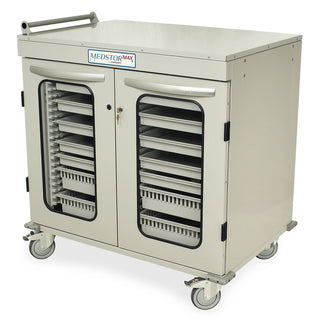
Treatment cabinets are freestanding units that hold procedure supplies at the point of use, and the mobile versions go where the procedure is instead of the procedure coming to them.
Fixed: the 8805 with five drawers and its 8805-A molded top version, the 8821 with two doors and a drawer and the 8822 with two doors and two drawers.
Mobile: the 8950 mobile treatment cabinet with five drawers and the 8950-A with molded top. A molded top has no seam between the surface and the raised edge, which means no joint for fluid to sit in and nothing to fail during repeated disinfection. On a surface that sees spills, that is a durability and cleanability advantage rather than a cosmetic one.
Secure and Specialist Storage
Narcotics and locked cabinets
The Graham-Field 3007 wall-mountable double-door narcotics cabinet provides fixed secure storage. Double-door construction means two locks between the drug and the room, which is a common requirement in controlled substance policy. Confirm what your state board and facility policy require, since the specification is set by regulation rather than by preference.
The Harloff MSPM42 half-height two-column cabinet with glass doors and key lock combines visibility with security, which suits supplies that need to be found quickly but not accessed freely.
Automated dispensing
Capsa's NexsysADC range gives controlled access with an audit trail per transaction: the NexsysADC 4T compact at 150 SKU capacity and the full-size unit with 3-CAM. The value is the record rather than the lock: an automated cabinet documents who took what and when, which is what a controlled substance reconciliation actually needs.
Endoscope storage and drying
A reprocessed flexible endoscope retains moisture in its channels, and residual moisture supports microbial growth during storage, which is why drying cabinets exist as a distinct category. The Capsa TruAir drying cabinet with HEPA-filtered forced air channel drying holds 18 flexible endoscopes, and the TruAir storage cabinet with HEPA filter fan covers storage without channel drying.
Whether your setting requires active channel drying or filtered storage depends on your reprocessing protocol and applicable guidance, so confirm with your infection prevention function before specifying. Also stocked: a low-profile two-tier suture storage rack.
Frequently Asked Questions
How do I plan a cabinet run for an exam room?
Start from the wall length available, subtract door swings and equipment positions, then choose widths that fill it rather than leaving awkward gaps. Casework is effectively permanent once installed and plumbed, so adding 12 inches later usually means replacing a run rather than extending it. Matched base and wall combinations remove the alignment and finish-matching problem, which is worth considering where the run has to look deliberate.
Should I choose doors or drawers?
Doors give bulk volume for items retrieved occasionally. Drawers give findability for items retrieved several times a day, because getting a small item from the back of a deep cabinet means kneeling and unpacking. Most exam rooms need both, which is why the Clinton range offers mixed configurations at each width. Map your high-frequency items first, then allocate drawers to them.
What is a molded top and why does it matter?
A molded top is formed as one piece with no seam between the surface and the raised edge, so there is no joint for fluid to collect in and nothing to separate during repeated disinfection. On a treatment surface that sees spills, it is a cleanability and durability feature rather than a cosmetic one. A seamed top eventually opens at the joint, and once it does the surface cannot be reliably decontaminated.
What do I need to check before ordering a cabinet with a sink?
Supply and waste positions against the cabinet's cutout, before the run is finalised. Moving a sink cabinet after installation means moving plumbing, which is a different order of work from repositioning a cabinet. Confirm the rough-in locations with whoever is doing the fit-out and check them against the specific cabinet's dimensions rather than assuming a standard position.
What secure storage do controlled substances require?
That is set by regulation and your facility policy rather than by preference. Requirements commonly cover the construction of the cabinet, how it is fixed in place, the number of locks, and how access is documented. Double-door narcotics cabinets provide two locks between the drug and the room. Automated dispensing cabinets add a per-transaction record, which is what a reconciliation actually needs. Confirm the requirement with your pharmacy and compliance function before ordering.
What does an automated dispensing cabinet add over a locked cabinet?
The record. A lock controls who can open the cabinet; an automated dispensing cabinet documents who took what and when, per transaction. For controlled substance reconciliation, that audit trail is the point. Capacity is quoted in SKUs rather than volume, so match it to the number of distinct items you stock rather than the total quantity.
Why do endoscopes need a drying cabinet?
A reprocessed flexible endoscope retains moisture inside its narrow channels, and residual moisture supports microbial growth during storage. A drying cabinet passes HEPA-filtered air through those channels to remove it, which storage alone does not do. Whether your setting requires active channel drying or filtered storage depends on your reprocessing protocol and applicable guidance, so confirm with your infection prevention function.
What is the difference between a treatment cabinet and casework?
A treatment cabinet is a freestanding unit holding procedure supplies at the point of use, available fixed or on casters. Casework is fitted base and wall cabinetry that becomes part of the room. Treatment cabinets can be relocated or added without a fit-out, which suits rooms whose function changes, while casework gives more storage per square foot in a room whose layout is settled.
Are colour options available?
The Fashion Finish wall cabinet range offers colour options, which is commonly used in pediatric and outpatient settings where the clinical look is being deliberately softened. If you are matching an existing installation, confirm the finish name and code with us before ordering rather than matching from a screen, since colour reproduction on a monitor is unreliable.
Does casework ship assembled?
Base and wall cabinets generally arrive assembled by freight and require installation, including wall fixing for wall cabinets and plumbing connection for sink units. Mobile treatment cabinets typically arrive ready to use. Installation is not usually included, so plan for a fitter. For a multi-room fit-out, request a quote so freight can be consolidated and delivery timed to the build schedule.
MediDepot Purchasing Advantages
- Price Match Guarantee: found the same model number for less elsewhere? We will match the verified price.
- Equipment Financing: casework is a fit-out cost; financing spreads it across the year.
- Extended Warranty: coverage on locking mechanisms and drawer slides beyond the manufacturer term.
- Military Discount: available for qualifying military medical facilities and personnel.
- Request a Quote: run planning, finish matching across rooms, and delivery timed to your build schedule.
Related Buying Guides
- Physician Office Setup Checklist
- Private Practice Equipment Buying Mistakes
- Clinic Infection Control Supplies Checklist
- Medical Equipment Financing Guide
- Medical Equipment Quote Comparison Checklist