


Mechanical Traction Head Units, Cervical Devices and Positioning
Mechanical traction applies a controlled pulling force along the axis of the spine, delivered by a head unit that generates and regulates the force, transmitted through a harness or halter to the patient positioned on a table. This collection carries Mettler Electronics traction equipment including a clinical head unit, a heavy duty cervical device and SlipStop positioning blocks.
Traction is one of the few therapy modalities where the equipment specification and the treatment outcome are tightly coupled, because a large part of the force you set at the unit never reaches the intended structures. Understanding where it goes is the difference between a traction setup that does what the prescription intended and one that reads the right number on a display while delivering considerably less.
→ Part of Physical Therapy & Rehab. Also see Therapy Tables, PT Treatment Tables, Pain Management and Rehabilitation Equipment.
Static or Intermittent?
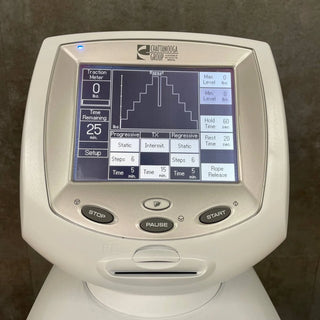
Static traction holds a constant force for the duration of the session. Intermittent traction cycles between a hold force and a lower rest force on a set rhythm. Both are standard modes on a clinical head unit, and the choice is a clinical decision rather than a preference.
| Mode | Force pattern | Generally used where |
|---|---|---|
| Static (continuous) | Constant hold throughout | Sustained stretch is the intent |
| Intermittent (cyclic) | Alternates hold and rest phases | Cyclic loading and unloading is the intent |
Force magnitude, hold and rest times, and total session duration are set by the treating clinician against the patient's presentation and the treatment goal. Those parameters are the prescription; the equipment is what delivers it reproducibly, which is the real argument for a clinical head unit over improvised arrangements.
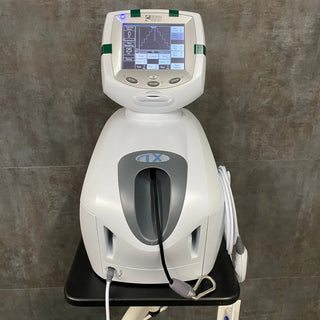
The Mettler ME-4000 MTD-4000 traction head unit is the generating unit here, with the TX traction unit and a traction package in burgundy as further options.
Why Friction Determines the Force That Actually Arrives
In lumbar traction, the pulling force has to overcome friction between the patient's body and the table surface before any of it reaches the spine. That friction is not a rounding error. The lower half of the body resting on a fixed table represents a substantial resisting load, and the force consumed overcoming it is force the treatment never receives.
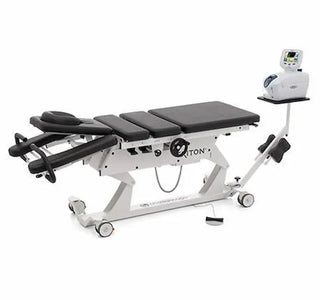
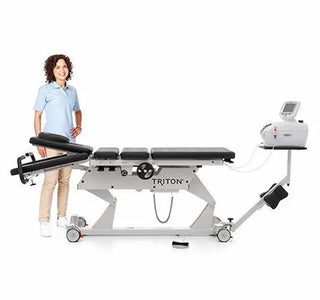
This is why split traction tables exist, with a section that releases and slides so the lower body moves with the pull rather than against it. On a fixed surface, the number on the display and the force at the tissue are different figures, and the gap is invisible from the console.
Cervical traction is less affected because the head is lighter and the halter arrangement lifts rather than drags, but positioning still changes the line of pull, and the line of pull changes which structures the force acts on.
Positioning blocks
The Mettler 40006 SlipStop traction blocks positioning set holds the patient in the intended position and resists sliding during the pull. Consistent positioning is what makes a repeat session comparable to the previous one; without it, the same settings produce a different treatment because the geometry changed.
Cervical Traction
Cervical traction applies force through a halter or head harness, and the angle of pull is as much a parameter as the force. Changing the flexion angle changes which segments the force preferentially affects, which is why cervical devices offer angle adjustment rather than a single fixed geometry.
The Mettler 40008 clinical cervical traction device, heavy duty is the dedicated unit in this collection. Heavy duty construction matters in a clinic setting for a straightforward reason: this equipment is set, adjusted and reset many times a day, and the components that carry load and the components that get handled are frequently the same ones.
Patient comfort is functional here rather than cosmetic. A halter that presses uncomfortably under the jaw causes the patient to tense against the pull, and a tensed patient resists the traction with their own musculature, which works directly against the treatment.
What a Complete Traction Setup Requires
A head unit alone does not deliver traction. The setup is a system, and buying one component leaves the others to be sourced separately.
- A head unit to generate and regulate force, with static and intermittent modes and a timer.
- A table the patient lies on, ideally with a split section for lumbar work so friction does not consume the applied force. See Therapy Tables and PT Treatment Tables.
- Harness or halter appropriate to the region being treated, sized to the patient.
- Positioning accessories such as blocks and bolsters to establish and hold the treatment position. See Positioning Wedges, Rolls & Bolsters.
- A patient stop control so the patient can release the pull immediately if it becomes uncomfortable, without waiting for a clinician to reach the unit.
That last point is worth stating plainly. Traction applies sustained force to a patient who is lying restrained and often cannot easily sit up. The ability to stop it themselves is not a convenience feature.
Continuous Passive Motion (CPM)
CPM is the other half of this category. A CPM device moves a joint through a set range of motion continuously, without the patient contracting the muscles that would normally produce the movement.
It is used most often after joint surgery, typically knee replacement or shoulder procedures, where the clinical concern is that a joint left immobile forms adhesions and loses range that is difficult to recover afterwards. The device maintains movement during the period when active movement is limited by pain, swelling or surgical restriction. Range, speed and session duration are set on the device and progressed according to the surgeon's protocol.
CPM is distinct from traction in every respect: traction applies a linear pulling force along an axis, CPM produces cyclical joint movement through an arc. They share this category because both are mechanically driven passive modalities in which the equipment does the work rather than the patient.
Whether CPM is indicated after a specific procedure, and for how long, is determined by the operating surgeon's protocol rather than by general practice, and that varies considerably between procedures and institutions.
Safety and Contraindications
Spinal traction has established contraindications, and screening for them is part of the assessment rather than an optional step.
Broadly, mechanical traction is contraindicated or requires specialist caution in the presence of malignancy affecting the spine, spinal infection, acute fracture or instability, significant osteoporosis, inflammatory arthropathy with cervical instability, spinal cord compression or progressive neurological deficit, vertebrobasilar insufficiency for cervical traction, and uncontrolled hypertension or cardiovascular compromise. Pregnancy and recent spinal surgery also require specific assessment.
This is a general orientation rather than a complete screening list, and the decision belongs with the treating clinician who has assessed the patient and reviewed their imaging and history. Read the instructions for use for the specific device, and follow your service's protocol for screening before treatment.
Frequently Asked Questions
What is the difference between static and intermittent traction?
Static traction holds a constant force throughout the session. Intermittent traction cycles between a hold force and a lower rest force on a set rhythm. Both are standard modes on a clinical head unit. Which is used, at what force and for how long, is set by the treating clinician against the patient's presentation and the treatment goal rather than being a general preference.
Why does friction matter in lumbar traction?
Because the pulling force must overcome friction between the patient's body and the table before any of it reaches the spine. The lower half of the body on a fixed surface is a substantial resisting load, and force spent overcoming it never reaches the treatment. That gap is invisible from the console: the display shows the force applied at the unit, not the force arriving at the tissue.
What is a split traction table for?
It has a section that releases and slides so the lower body moves with the pull rather than being dragged against the table surface. That removes most of the friction losses in lumbar traction, so the force set at the unit is much closer to the force delivered. On a fixed table, a considerable proportion of the applied force is consumed before it reaches the spine.
Why do cervical traction devices adjust the angle of pull?
Because the flexion angle changes which segments the force preferentially affects. Angle is a treatment parameter alongside force and duration, not a comfort adjustment. A device with fixed geometry can only deliver one line of pull, which limits what the clinician can target.
Why does patient comfort affect traction effectiveness?
Because a patient who is uncomfortable tenses against the pull, and tensed musculature resists the traction directly. A halter pressing under the jaw or a position the patient cannot sustain produces guarding, and guarding works against the force the equipment is applying. Comfort here is functional rather than cosmetic.
What do I need besides a traction head unit?
A table for the patient, ideally split for lumbar work; a harness or halter appropriate to the region and sized to the patient; positioning accessories such as blocks and bolsters to establish and hold the position; and a patient stop control. The head unit generates and regulates the force, but on its own it does not constitute a traction setup.
Why do positioning blocks matter?
They hold the patient in the intended position and resist sliding during the pull. Consistent positioning is what makes one session comparable to the last: if the geometry changes, the same settings produce a different treatment. Without positioning control, session-to-session variation comes from the setup rather than from the patient's response, which makes progress difficult to interpret.
Why does a traction patient need their own stop control?
Because traction applies sustained force to a patient who is lying restrained and frequently cannot sit up to reach the unit. The person who first knows the force has become uncomfortable is the patient, and they need to be able to release it immediately rather than waiting for a clinician to notice or return to the room.
What is continuous passive motion and when is it used?
A CPM device moves a joint through a set range continuously without the patient contracting the muscles that would normally produce the movement. It is used most often after joint surgery such as knee replacement or shoulder procedures, where a joint left immobile can form adhesions and lose range that is difficult to recover. Whether it is indicated after a specific procedure, and for how long, is determined by the operating surgeon's protocol.
When is spinal traction contraindicated?
Broadly, in the presence of spinal malignancy, spinal infection, acute fracture or instability, significant osteoporosis, inflammatory arthropathy with cervical instability, spinal cord compression or progressive neurological deficit, vertebrobasilar insufficiency for cervical traction, and uncontrolled cardiovascular compromise, with pregnancy and recent spinal surgery requiring specific assessment. This is a general orientation rather than a complete screening list, and the decision belongs with the treating clinician who has assessed the patient.
MediDepot Purchasing Advantages
- Price Match Guarantee: found the same model number for less elsewhere? We will match the verified price.
- Equipment Financing: useful when a head unit, table and accessories are bought together as a system.
- Extended Warranty: coverage on drive mechanisms and controls beyond the manufacturer term.
- Military Discount: available for qualifying military medical facilities and personnel.
- Request a Quote: matching a head unit to a table, harness sizing and complete system pricing.
Related Buying Guides
- Physical Therapy Equipment by Condition
- Private Practice Equipment Buying Mistakes
- Physician Office Setup Checklist
- Medical Equipment Quote Comparison Checklist