





Single and Multichannel Pipettes, Controllers, Tips and Serological Pipettes
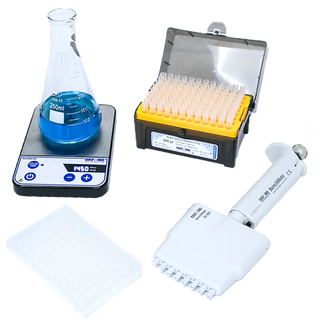
This collection covers the full liquid handling chain: adjustable-volume pipettes in single, eight and twelve channel formats, electronic pipettes and controllers, universal and filtered tips, serological pipettes from 1 to 50 mL, and the racks and holders that keep them organised. Brands include NEST Scientific, Heathrow Scientific, Oxford, Dynarex LabChoice and Benchmark Scientific Accuris.
Two decisions here have more effect on results than most people expect, and both concern tips rather than pipettes.
The first is low retention. Standard polypropylene holds a thin film of liquid on the inner wall, and for most aqueous work that loss is negligible. For small volumes, viscous solutions, detergent-containing buffers or anything precious, it is not, and the same tip that works fine for buffer transfers can quietly cost you several percent on a 2 µL enzyme aliquot. The second is filtered tips, which matter whenever aerosol carryover into the pipette barrel would contaminate the next sample. In PCR setup that is not an optional refinement.
→ Part of Consumables & Plasticware. Also see Blood Collection Supply, Molecular Biology & Genomics, Hoods & PCR Workstations.
Single Channel, Multichannel or Electronic?
Channel count should match the plate format you work in, and electronic pipettes earn their cost where the same repetitive action happens many times a day.
| Format | Best For | Consideration |
|---|---|---|
| Single channel | Tube work, reagent preparation, general bench use | The bench default; most labs need several volume ranges |
| Eight channel | 96-well plates by column, 8-strip tubes | Matches a plate column exactly |
| Twelve channel | 96-well plates by row | Matches a plate row; choose by how you fill plates |
| Electronic | High repetition, serial dilution, reverse pipetting | Reduces repetitive strain; needs charging discipline |
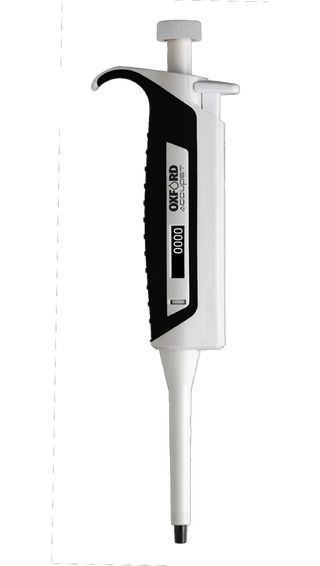
Multichannel options include the Heathrow eight channel at 30 to 300 µL, the Heathrow twelve channel and Dynarex LabChoice mechanical pipettes in eight or twelve channel. Single channel: Heathrow adjustable volume and Benchmark Accuris NextPette. Electronic: the Dynarex electronic pipette.
For a lab starting out, the Heathrow pipette starter kit covers the common volume ranges in one purchase, which is usually cheaper than assembling them individually.
Pipette Tips: Low Retention, Filtered and Racked
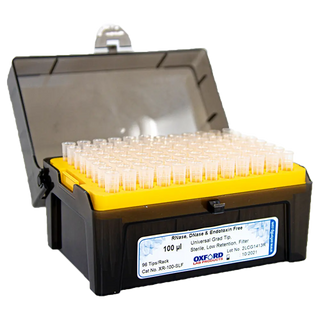
Tip selection comes down to three properties: whether the tip is low retention, whether it has a filter, and whether it arrives racked and sterile. Each addresses a different problem and they combine independently.
Low retention
Standard polypropylene retains a film of liquid on the tip's inner surface. Low retention tips use a surface treatment that reduces that film, so more of the volume you aspirated is actually delivered. The effect scales inversely with volume, so it matters most at small volumes and with liquids that wet the surface readily: detergent-containing buffers, protein solutions, glycerol stocks. NEST's range is low retention throughout: 10 µL, 200 µL, 300 µL and 1000 µL.
Filtered tips
A filter tip has a barrier in the upper part of the tip that stops aerosol reaching the pipette barrel. Without it, aerosol from one sample can deposit inside the pipette and carry into the next. For PCR setup, where a trace of amplified product contaminating a reaction produces a false result, filtered tips are standard practice rather than an upgrade. See NEST 200 µL filtered, low retention, sterile and Dynarex universal tips with filter. Where filtering is not required, unfiltered universal tips cost less.
Extra long tips
For reaching the bottom of deep tubes without contaminating the pipette shaft on the tube wall, 10 µL extra long racked tips.
Serological Pipettes From 1 to 50 mL
Serological pipettes handle the volumes air-displacement pipettes cannot, from 1 mL up to 50 mL, and are used with a controller rather than by mouth or by hand plunger. They are the standard tool for cell culture media handling.
NEST's range carries negative graduation, meaning the scale continues past the nominal volume: the 1 mL has 0.4 mL of negative graduation, the 5 mL has 2.5 mL, the 25 mL has 7 mL. That extra range means you can draw slightly more than nominal when needed rather than reaching for the next size up, which in cell culture saves both a pipette and a hood interruption.
Sizes available: 1 mL, 2 mL, 5 mL, 10 mL, 25 mL and 50 mL.
Packaging: individually wrapped or bulk case
Individually wrapped sterile pipettes suit cell culture work where each one is opened at the hood. Bulk sterile cases cost less per unit and suit higher-throughput use where a batch is opened at once: 10 mL in cases of 1500, 25 mL in cases of 800 and 50 mL in cases of 600. Plastic-wrapped individual options also exist where paper wrap sheds fibres in a critical environment.
Controllers and fillers
Serological pipettes need a controller. Options include the Heathrow HS3000/RF3000 controller and the Dynarex LabChoice rechargeable filler.
Racks, Holders and Bench Organisation
Pipettes stored lying on a bench get knocked, and a dropped pipette needs recalibration whether or not it looks damaged. Vertical storage is cheap insurance on instruments that cost several hundred dollars each.
Options include the Integra/Sartorius six-position pipettor rack, a multichannel pipette hanger, a combined multichannel and pipette aid holder and horizontal tip organizers.
For serological pipettes, PETG pocket holders come in 4, 5 and 6 pocket versions, and modular systems build out as the lab grows: one column starter set with supplementary units, or a two column starter set with matching supplements. Wall-mounted options save bench space entirely.
Frequently Asked Questions
What are low retention pipette tips and when do I need them?
Low retention tips use a surface treatment that reduces the film of liquid clinging to the inner wall, so more of the aspirated volume is actually delivered. The effect matters most at small volumes and with liquids that wet plastic readily: detergent-containing buffers, protein and enzyme solutions, glycerol stocks and anything viscous. For routine aqueous transfers at larger volumes the difference is small; for a 2 µL enzyme aliquot it is not.
When do I need filtered pipette tips?
Whenever aerosol reaching the pipette barrel would carry contamination into the next sample. PCR setup is the clearest case: a trace of amplified product carried between reactions produces a false result that is difficult to trace. Filtered tips are also used for RNA work, for anything infectious, and where a valuable pipette needs protecting from corrosive or radioactive material. For routine buffer transfers, unfiltered tips are adequate and cheaper.
Should I buy an eight channel or a twelve channel pipette?
It depends on how you fill a 96-well plate. An eight channel matches a column, a twelve channel matches a row. If your plate maps have samples running down columns, use eight; if they run across rows, use twelve. Labs doing both often keep one of each. Eight channel also matches 8-strip PCR tubes, which is a common secondary use.
Are electronic pipettes worth the extra cost?
Where the same action is repeated many times a day, yes, for two reasons. Repetitive pipetting is a documented cause of hand and wrist strain, and an electronic pipette removes the plunger force from that equation. It also delivers more consistent volumes than a person can, because the aspiration and dispense speeds do not vary with fatigue. For occasional bench use, a mechanical pipette is simpler and has nothing to charge.
Do universal pipette tips fit all pipettes?
Universal tips are designed to fit most standard pipette shafts, but fit is not guaranteed across every brand and model, and a tip that does not seal properly will not deliver the correct volume. If you are changing tip supplier, test the fit with your actual pipettes before committing to a case quantity. A poor seal is not always obvious by eye but it shows up in the numbers.
What is negative graduation on a serological pipette?
Negative graduation means the scale continues past the nominal volume, so a 5 mL pipette with 2.5 mL negative graduation can measure beyond 5 mL. It lets you draw a little more than nominal without reaching for the next size, which in cell culture avoids opening another pipette and interrupting work in the hood. The larger sizes in this collection all carry it.
Should serological pipettes be individually wrapped or bulk packed?
Individually wrapped sterile suits cell culture, where each pipette is opened at the hood as needed and the wrapper is the sterility barrier until that moment. Bulk sterile cases cost less per unit and suit higher-throughput work where a batch is opened at once. Plastic-wrapped individual options exist for environments where paper wrap shedding fibres is a concern.
How often should pipettes be calibrated?
Calibration interval should follow your quality system, the manufacturer's recommendation and how heavily the pipette is used, with heavily used instruments checked more often. Beyond the scheduled interval, a pipette that has been dropped should be recalibrated before further use regardless of when it was last checked, since internal damage is not visible externally. Many labs also run a periodic gravimetric check between formal calibrations.
How should pipettes be stored?
Vertically, in a rack or on a hanger, with the volume set to the top of the range if the manufacturer recommends it. Pipettes lying on a bench get knocked onto the floor, and a dropped pipette needs recalibration whether or not it looks damaged. Racks and hangers cost a fraction of one pipette and prevent the most common way they are damaged.
What does racked and sterile mean on pipette tips?
Racked means the tips arrive pre-loaded in a tray so a pipette can be tipped directly without handling, which both saves time and avoids touching the tip. Sterile means they have been sterilised and are supplied in sealed packaging. Bulk bagged tips cost less but must be racked by hand, which is fine for non-critical work and unacceptable where handling would compromise sterility.
MediDepot Purchasing Advantages
- Price Match Guarantee: found the same catalogue number for less elsewhere? We will match the verified price.
- Equipment Financing: available when consumables are part of a larger laboratory equipment order.
- Extended Warranty: available on qualifying instruments.
- Military Discount: available for qualifying military medical and research facilities.
- Request a Quote: case quantity pricing, standing consumable orders and tip compatibility questions.
Related Buying Guides
- Lab Equipment Supplier Guide: How to Evaluate Vendors
- Model Number Comparison Guide
- How to Verify Authorized Medical Equipment Sellers
- Medical Equipment Quote Comparison Checklist