


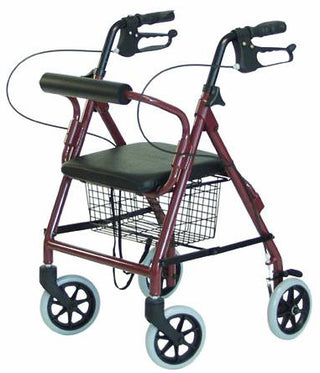
What Makes a Walker Bariatric
A bariatric walker is built around a reinforced frame with thicker tubing, stronger welds and a wider opening so it carries more weight and fits a wider user. Standard adult walkers are rated 300 to 350 lb. The walkers in this collection are rated 400 to 500 lb.
Capacity is only half of it. The frame opening is the other half, and it is the one people forget. A 500 lb walker with a narrow opening is unusable for a wide user, because they cannot stand inside the frame where their weight is supported. Both numbers are on every product page.
Capacity and Frame Width
Buy for the actual loaded weight plus margin, and measure the user at the widest point, usually the hips.
| Rated capacity | Typical frame opening | Suits |
|---|---|---|
| 400 lb | Around 26 inches | Users to about 380 lb who fit a standard width |
| 450 to 500 lb | 26 to 30 inches | Heavier users, and users needing a wider stance |
Leave margin. A walker loaded to its exact limit flexes more and the user feels that flex as instability, which defeats the point of the frame.
Measure Your Doorways First
This is the step that goes wrong most often. A bariatric walker can be 30 inches or more across the base. A standard interior door is 30 inches and a bathroom door is often 28. Measure the narrowest doorway the walker has to pass, and compare it against the overall width on the product page, not the frame opening.
If the widest frame will not pass the narrowest door, the choice is a narrower frame, a different route, or widening the door. Finding that out after delivery is an expensive discovery with an oversize item.
Wheels or No Wheels
Bariatric walkers come in the same two forms as standard ones. A non-wheeled frame is lifted and placed each step and gives the most stability. A front wheeled frame rolls forward on two wheels with rubber tips or glides behind, which is easier on the shoulders and wrists.
At bariatric weights the lifting question matters more, because the frame itself is heavier. If the user tires lifting it, they will stop using it. Several frames in this collection are front wheeled for exactly that reason, and they also appear in Front Wheeled Walkers.
Height and Fit
Handle height adjusts on every model here. Stand inside the frame in normal shoes with arms relaxed at the sides; the handgrips should sit level with the wrist crease, which puts a slight bend in the elbow. That bend is where the arms can actually take load.
When a Walker Is Not Enough
If the user cannot walk the distances they need even with a bariatric frame, or cannot stand long enough, a rollator with a seat lets them rest on the way. Bariatric rollators are in 4 Wheel Rollators. If standing itself is the problem, see Bariatric Wheelchairs or Heavy Duty Scooters.
Frequently Asked Questions
What capacity counts as a bariatric walker?
400 lb and above in this collection. Standard adult walkers stop at 300 to 350 lb.
Is there a 1000 lb walker?
Not as a walking frame. Walkers top out around 500 lb because the user's own balance limits what a frame can safely support. Above that, transfer and lifting equipment takes over; see Patient Lifts & Transfer Systems.
How wide is a bariatric walker?
Typically 26 to 30 inches across the base, with some wider. The exact overall width is on each product page. Measure your narrowest doorway before ordering.
Will it fit through a bathroom door?
Often not. Bathroom doors are frequently 28 inches. Check the overall width against that specific door, because the bathroom is usually the room the walker is most needed in.
What is the difference between frame opening and overall width?
Frame opening is the space the user stands in. Overall width is the outside dimension that has to pass a doorway. Size the opening to the user and the overall width to the house.
Should I get wheels on a bariatric walker?
If lifting the frame tires the user, yes. Bariatric frames are heavier, so the lifting effort is greater than on a standard walker, and a user who finds it tiring stops using the walker.
How much does a bariatric walker weigh?
Typically 8 to 12 lb, heavier than a standard aluminium walker because of the reinforced tubing. Each product page gives the figure.
Can two people use the same bariatric walker?
Only one at a time, and the height needs resetting between users. Handle height is set to the individual, so a shared walker fitted to one person is the wrong height for the other.
Does Medicare cover a bariatric walker?
Walkers are generally covered as durable medical equipment when a physician documents medical need, but coverage, supplier rules and your share of cost depend on your plan. We are not able to bill your insurance for you. Check with your plan and your physician before you order, and keep the invoice.
Do bariatric walkers need special replacement tips?
Yes, larger diameter tips to match the heavier tubing. Standard tips will not fit. Replacements are in Walker Accessories.
MediDepot Purchasing Advantages
- Shipped from US stock, so you are not waiting on an overseas order.
- Manufacturer warranty on every frame, handled by us.
- Rated capacity, frame opening and overall width on every product page, so you can size the walker to the user and the house before buying.
- Bariatric tips, glides and wheels stocked separately.
- Bulk and facility pricing available for clinics, rehab units and care homes.
Related Buying Guides
- Walker weight capacity and bariatric sizing
- Measuring doorways for mobility equipment
- Fitting walker handle height correctly
- Walker tips and glides: when to replace them