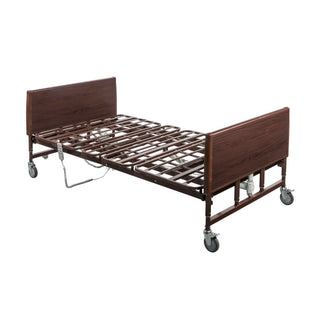
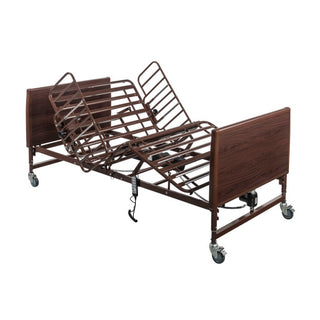
Powered Head, Foot and Height Adjustment for Home Care and Facilities
A full electric bed powers all three movements: head elevation, foot elevation and overall bed height. A semi-electric bed powers only head and foot, leaving height adjustment to a hand crank. That third motor is what lets a caregiver bring the bed down to transfer height and back up to a working height without bending, and it is the reason full electric is the standard specification for anyone doing daily care.
The crank on a semi-electric bed sounds like a minor compromise until you have used one. It sits at the foot of the bed, it takes both hands and about forty turns to make a meaningful height change, and in practice nobody uses it. The bed gets set once at whatever height it happened to be and stays there, which defeats the purpose. If height adjustment matters at all, it needs to be on a button.
This collection covers 20 models from Drive DeVilbiss, Dynarex, Invacare, Lumex, Proactive Medical and Rhythm Healthcare, in standard, low and bariatric configurations, with several available as packages including rails and a mattress.
→ Part of Hospital Beds. Also see Bariatric Beds, Bed Accessories, Mattresses & Support Surfaces.
Standard Height or Low Bed?
A low bed drops closer to the floor than a standard bed, which reduces injury severity if a patient rolls out. It is a fall management decision, not a comfort decision, and it is the single most common reason facilities specify one bed over another.
When a low bed is the right call
- The patient has a documented fall history or is assessed as high fall risk.
- Cognitive impairment means the patient may attempt to get up unassisted and unpredictably.
- Your care plan uses a floor mat alongside the bed, which only works if the bed goes low enough.
Low models in this collection include the Drive 15005LP at 80 inches with a spring deck, the Delta Ultra Light 1000 Low at 88 inches, and the Rhythm Healthcare H9600 series in full rail and half rail versions, both supplied with a PulseProtect mattress.
When standard height is better
If the patient transfers to a wheelchair or commode regularly and fall risk is low, a standard-height bed puts the transfer surface at a more useful level and reduces the strain on whoever is assisting. A bed that spends its life at the bottom of its range is harder on caregivers, not easier.
80 Inch or 88 Inch Bed Length?
Standard hospital beds are 80 inches long. The 88 inch length exists for taller patients, and once you need it there is no substitute. A patient whose feet press against the footboard cannot be positioned properly, develops heel pressure issues faster and will not sleep well.
The Delta Ultra Light 1000 range covers both. The 15033 at 88 inches is the long version, available with full rails or half rails. On the low side, the 15235BV-PKG-1-T at 80 inches and the 88 inch version with full side rails give you the same choice.
Measure the room before you order the 88 inch. It is eight inches longer than the standard and in a home bedroom that can be the difference between a door that opens and one that does not.
Half Rails or Full Rails?
Half rails cover the upper half of the bed and support repositioning and sitting up. Full rails run most of the bed length and are used where a patient is at risk of rolling out. Rail selection is a clinical assessment, not a default, and it has a genuine safety dimension in both directions.
Rails prevent some falls and create a different risk at the same time. Entrapment between the rail, the mattress and the frame is a recognized hazard that the FDA and the Hospital Bed Safety Workgroup have published dimensional guidance on. The practical implications: the mattress must fit the frame with no significant gap, rails must be the ones designed for that bed, and gaps that do exist should be filled with a purpose-made rail guard rather than a rolled towel. See Bed Accessories for gap fillers and rail wedges.
Package options that ship with rails and a mattress matched to the frame remove the guesswork: the Ultra Light package with half rails and mattress and the full rail equivalent.
Bariatric Full Electric Beds
Bariatric beds differ from standard beds in two ways that both matter: a higher safe working load and a wider sleep surface. Weight rating is a structural limit on the frame and motors. Width is about whether the patient can be repositioned and turned without their limbs hanging off the edge. You need to specify both.
| Model | Width / Capacity | Notes |
|---|---|---|
| Drive 15300LW | 42 inch wide, 80 inch long | Lightweight bariatric frame for home care |
| Drive 15303LW | 54 inch wide, 80 inch long | Wider surface for repositioning and turning |
| Invacare BAR750 | 750 lb class | Supplied with half rails; bolster available separately |
| Lumex GS4054D Maxi-Rest | 1000 lb safe working load | Highest capacity in this collection |
| Dynarex Bari-Max HD | Heavy duty bariatric | Matching Bari-Max rails and trapeze available |
One thing that catches people out: a bariatric bed needs a bariatric mattress and bariatric rails. A standard 36 inch mattress on a 54 inch frame leaves an 18 inch gap, which is both useless and an entrapment hazard. Order the surface with the frame.
Compare Full Electric Beds
| Model | Height Class | Length | Distinguishing Feature |
|---|---|---|---|
| Drive 15005LP | Low, hi-low range | 80 in | Spring deck, three powered functions |
| Drive 15005LP-HRPKG-TS | Low | 80 in | 350 lb rating, half rail package |
| Drive 15033 Delta Ultra Light | Standard | 88 in | Extended length for taller patients |
| Drive 15235 Delta Low | Low | 88 in | Fall management plus extended length |
| Rhythm H9600FF-1 | Low | Standard | Full rails plus PulseProtect mattress included |
| Dynarex 3-Motor Hi-Low | Hi-low | Standard | Three-motor configuration for home care |
| Proactive Protekt Akra FE | Standard | Standard | Full electric home care platform |
| Lumex GS4054D Maxi-Rest | Bariatric | Standard | 1000 lb safe working load |
Frequently Asked Questions
What is the difference between a full electric and a semi-electric hospital bed?
A full electric bed powers head elevation, foot elevation and overall bed height. A semi-electric bed powers head and foot only, with height adjusted by a hand crank at the foot of the bed. In practice the crank goes unused because it takes both hands and dozens of turns, so the bed stays at one height. If height adjustment matters for transfers or caregiver back safety, full electric is the specification you want.
When should I choose a low hospital bed?
Choose a low bed when the patient has a fall history, is assessed as high fall risk, or has cognitive impairment that makes unassisted attempts to get up likely. A low bed reduces the height of any fall and works alongside a floor mat as part of a fall management plan. If the patient transfers regularly to a wheelchair and fall risk is low, a standard-height bed makes those transfers easier.
Do I need an 80 inch or an 88 inch bed?
Standard is 80 inches. Choose 88 inches when the patient is tall enough that their feet would press against the footboard, which prevents proper positioning and accelerates heel pressure problems. Measure the room first: an 88 inch bed is eight inches longer, and in a domestic bedroom that can determine whether the door still opens.
Half rails or full rails?
Half rails cover the upper half of the bed, giving the patient something to hold while repositioning or sitting up, and leaving the lower half clear for transfers. Full rails run most of the length and are used where the patient is at risk of rolling out. Rail choice should follow a clinical assessment rather than a default, since rails prevent some falls while introducing entrapment risk that has to be managed separately.
What is bed rail entrapment and how do I prevent it?
Entrapment is when a part of the body becomes caught in a gap between the rail, the mattress, the headboard or the frame. The FDA and the Hospital Bed Safety Workgroup have published dimensional guidance on the zones where this occurs. Prevention comes down to three things: use rails designed for that specific bed, use a mattress sized to the frame with no significant perimeter gap, and fill any remaining gaps with a purpose-made rail guard or wedge rather than improvised padding. Rolled towels and pillows are not a substitute.
What weight capacity does a standard hospital bed have?
Standard home care beds are typically rated in the 350 to 450 lb range. Bariatric beds in this collection run from the 750 lb class up to the Lumex GS4054D at 1000 lb safe working load. Rated capacity is a structural limit on the frame and motors, not a comfort suggestion, and it must include the mattress and any equipment on the bed, not just the patient.
Does a bariatric bed need a special mattress?
Yes. A bariatric frame at 42 or 54 inches wide needs a mattress cut to that width. A standard 36 inch mattress leaves a perimeter gap that is both clinically useless and an entrapment hazard. Bariatric rails are also frame-specific. Order the surface and the rails with the frame rather than separately.
Do these beds come with a mattress?
Some do. Package configurations such as the Drive Ultra Light packages and the Rhythm Healthcare H9600 series ship with rails and a mattress matched to the frame. Others are frame only. Individual product pages specify what is included. If you are unsure whether a package or a separate mattress selection suits your situation, request a quote and we will confirm.
Is a hospital bed covered by Medicare?
Hospital beds may be covered as durable medical equipment when specific medical necessity criteria are met and documented by the prescribing physician. Coverage rules, documentation requirements and the distinction between semi-electric and full electric under those rules are set by the payer rather than by the supplier. Our Medicare Part B coverage guide is a starting point, and your physician's documentation is the deciding factor.
How are hospital beds delivered and assembled?
Beds ship by freight, usually in components that assemble on site: frame sections, head and foot boards, motors and rails. Assembly typically needs two people and basic tools. Measure your access route before delivery, including doorway widths, stair turns and the room itself, since a fully assembled bed will not go through a standard interior door.
MediDepot Purchasing Advantages
- Price Match Guarantee: found the same bed model for less elsewhere? We will match the verified price.
- Equipment Financing: spread the cost of a bed and support surface across monthly payments.
- Extended Warranty: coverage on motors, actuators and hand controls beyond the manufacturer term.
- Military Discount: available for qualifying military personnel, veterans and facilities.
- Request a Quote: bed and mattress matching, rail selection, multi-unit facility pricing and delivery coordination.
Related Buying Guides
- Hospital Beds for Home Use: Expert Buyer's Guide
- Sit-to-Stand vs Hoyer Lift: Safety and Staffing
- Patient Lift Sling Types Explained
- Medicare Part B Coverage Guide
- Medical Equipment Financing Guide
- How to Clean and Maintain Your Mobility Aid
Browse Related Collections
- All Hospital Beds
- Bariatric Beds
- Bed Accessories
- Mattresses & Support Surfaces
- Alternating Pressure Mattresses
- Positioning Wedges, Rolls & Bolsters
- Patient Lifts & Transfer Systems
- Patient Lifts
- Clinical Care Recliners
- Patient Room Furniture
- All Hospital Furniture