


Electric Hi-Low, Bobath, Tilt and Traction Tables
A physical therapy treatment table differs from a general exam table in three ways that matter daily: the height adjusts under load, the surface is wide enough to work around a patient, and the frame tolerates force applied off-centre. This collection carries 61 tables from Pivotal Health Solutions, Bailey Manufacturing, Mettler Electronics, Clinton Industries, Healthy You and Armedica, covering electric hi-low, Bobath, tilt, traction and multi-section motorised configurations.
Height adjustment is the specification that separates a therapy table from everything else, and the reason is not comfort. A therapist works over a patient with their own body weight involved, applying force through their arms into tissue for extended periods. If the table is at the wrong height, the therapist compensates through their back, session after session, for years. Height adjustment protects the clinician as much as it positions the patient.
→ Part of Therapy Tables. Also see Mat Tables & Platforms, Portable Treatment Tables, Traction & CPM and Rehabilitation Equipment.
Electric Hi-Low Tables
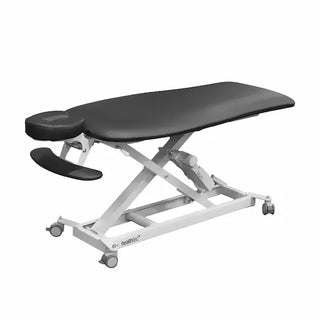
An electric hi-low table adjusts height under load at the press of a control, which matters both for patient transfer and for setting working height per therapist and per technique.
The patient side is the obvious one: a table that drops low enough for someone to sit and pivot on removes a transfer that would otherwise need assistance or a step. The clinician side is less visible but accumulates. Manual therapy performed at a fixed height forces a therapist of the wrong stature to work bent or with raised shoulders, and different techniques call for different heights on the same patient in the same session.
Pivotal Health's electric range covers this: the Thera-P electric treatment table, the Essential Thera-P electric, the ME2000 elevating table and the Healthy You HealthEC Lynx contour electric table at 28 inches wide.
Bariatric electric
Bariatric versions reinforce the frame and lift mechanism and widen the surface: the Thera-P bariatric electric, the Essential Thera-P bariatric electric and the ME2001 bariatric elevating table. Width matters alongside capacity here: a patient wider than the surface has no stable place for their arms, and the therapist has no room to work at the side.
Bobath Tables: Width Is the Point
A Bobath table is wider than a standard treatment table so the therapist can work from either side, kneel on the surface alongside the patient, and handle a patient through movements that would take them off a narrow table.
The name comes from the Bobath approach in neurological rehabilitation, where treatment involves guiding movement transitions such as rolling, coming to sitting and moving between positions, rather than a patient lying still while something is applied to them. A standard-width table simply does not accommodate that work: the patient runs out of surface partway through the transition.
Options: the Pivotal Health Thera-P Bobath electric treatment table and a second Bobath configuration. For floor-level and mat-based neurological work, see Mat Tables & Platforms.
Tilt Tables
A tilt table moves a patient from horizontal toward vertical in controlled increments while they remain supported and strapped, which allows upright tolerance to be rebuilt gradually in someone who has been immobile.
The clinical problem it addresses is real and often underestimated. A person confined to bed for an extended period loses the cardiovascular reflexes that maintain blood pressure on standing, and attempting to stand them produces dizziness, hypotension and a genuine fall risk. A tilt table lets the angle be raised in stages, held, and reduced immediately if the patient's response requires it, with the patient never unsupported at any point.
Options: the Bailey 9505 electric professional tilt table at 350 lb, 31 inch height, an electric professional tilt table and a home model manual tilt table.
Electric operation matters more here than on a general treatment table, because the therapist needs both hands free to monitor the patient and to lower the table immediately if the response demands it. Cranking a manual table while watching a patient go pale is not a workable arrangement in a clinical setting.
Traction and Decompression Tables
A traction table has a section that releases and moves with the pull, so applied force reaches the spine rather than being consumed overcoming friction between the patient and a fixed surface. That is what distinguishes it from an ordinary table with a traction unit attached.
The Mettler 4200 traction system, which includes a traction table with a motorized caudal section, is a complete system rather than a table alone. The ME-4200T traction table is the table component, and the ME-4100 complete Neural Flex decompression system covers decompression. Pivotal Health's Thera-P traction table is a further option.
See Traction & CPM for head units, cervical devices and positioning accessories.
Multi-Section Motorised Tables
Section count determines how finely the table can be shaped around a patient. Two sections give a head or back adjustment; seven and eight section tables articulate at the pelvis, thighs and lower legs independently.
More sections is not automatically better. Each articulation adds a joint that wears, a control to learn and cost, so the question is whether the additional positions are used in practice. A clinic doing general musculoskeletal work rarely needs eight sections; a chiropractic or specialist positioning practice may use every one of them daily.
- Mettler ME-4500 motorized two-section therapeutic table
- ME-4400 motorized three-section treatment table and the ME-4600 three-section therapeutic table
- ME-4700 motorized seven-section therapeutic table
- ME-4800 motorized eight-section chiropractic treatment table
Specialist positioning tables
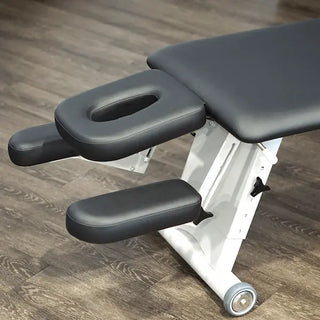
Some tables are shaped for a specific joint or approach rather than being general purpose: the Pivotal Health PT9060 leg and shoulder therapy table and the PT9080 hip and knee flexion treatment table. Also the Healthy You Eco chiropractic adjusting bench.
Fixed-Height, Portable and Space-Saving Tables
Wood and fixed-height tables
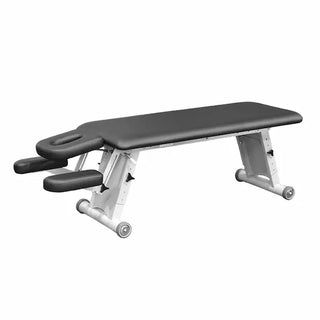
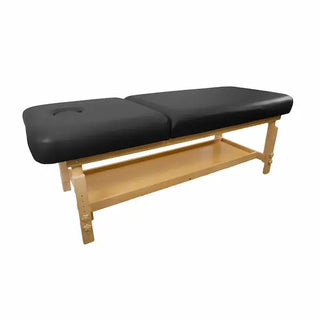
Where height adjustment is not required, wood-frame tables cost considerably less and have nothing to fail: the Premium wood treatment table, the NSK wood treatment table, the Edge Sport wood table, the 6-leg Edge Sport and the Pro 6-leg Edge Sport. Six-leg construction adds rigidity for manual work applied off-centre, which is exactly where a four-leg table racks.
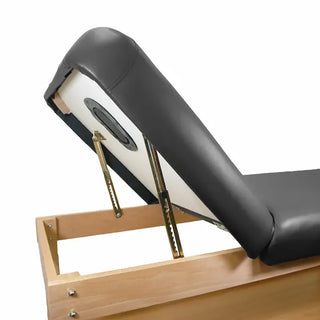
Also: the Armedica I9430 economy wood treatment table with adjustable backrest, the Bailey 345 professional exercise table at 350 lb, and Clinton couches including the 3620 hardwood leg couch, the 3710 panel leg couch with full shelf, the 3713 upholstered apron couch with double drawer storage and the 3900 KD panel leg couch with adjustable backrest.
Space-saving and portable
The wall-mount folding treatment table folds flat against the wall, which turns a treatment area into usable floor space between patients. That suits a room doubling as an exercise area. The Aluma-Elite basic treatment table, Aluma-Elite portable workstation and Aluma-Elite Pro portable workstation cover mobile and outreach work. See Portable Treatment Tables.
Recovery and teaching
Recovery surfaces: the Bailey 496 lounge recovery table, the Bailey 497 couch recovery table at 300 lb and the Pivotal Health recovery couch in wood or steel legs. Teaching settings: the classroom lab treatment table and the FESS Lab combination lab table and desk. Also a Healthy You stationary massage table with lift back and a Pivotal Health ET treatment cabinet.
Taping Stations, Mirrors and Clinic Equipment
Bailey's taping stations are built at working height for a standing therapist taping a seated athlete, rated at 500 lb: the Model 27 single station in 36 or 42 inch heights and the Model 26 dual station.
Posture mirrors give the patient visual feedback, which changes movement correction from something described to something seen: the Model 700 adult mobile posture mirror, the Model 701 mobile triple mirror, which shows front and both sides at once, and the Model 702 wall posture mirror.
Balance and pediatric equipment
The Bailey 3100 balance platform with 30 inches between uprights, the Model 227 rocker balance square, the Model 2400 child variable balance beam with 4 beams and 5 bases and the Model 2405 child convertible balance beam set. Pediatric seating: the Model 154 adjustable classroom chair and a Model 150 tray for the Kinder Chair. Handrail attachment: the 94A/94F series child's handrail attachment.
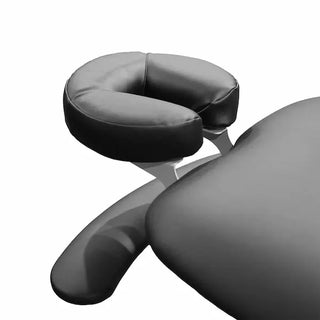
Workshop and fitting equipment: the Model 6030 lifting and bolt center and the Model 6031 wall-mounted work station. For patient comfort during prone work, the Mettler 40017 therapeutic memory foam face cushion.
Frequently Asked Questions
Why do physical therapists need height-adjustable tables?
Two reasons that both matter. Patients transfer more safely onto a table that drops to sitting height, removing a step or an assist. And the therapist works over the patient applying force through their arms for extended periods, so a table at the wrong height means compensating through the back, session after session. Different techniques also call for different heights on the same patient. Height adjustment protects the clinician as much as it positions the patient.
What is a Bobath table and why is it wider?
A Bobath table is wider than a standard treatment table so the therapist can work from either side, kneel on the surface beside the patient, and guide movement transitions such as rolling and coming to sitting. The name comes from the Bobath approach in neurological rehabilitation, where treatment involves guided movement rather than the patient lying still. On a standard-width table the patient runs out of surface partway through a transition.
What is a tilt table used for?
It moves a patient from horizontal toward vertical in controlled increments while they remain supported and strapped, allowing upright tolerance to be rebuilt gradually. A person immobile for an extended period loses the cardiovascular reflexes that maintain blood pressure on standing, so attempting to stand them produces dizziness, hypotension and a real fall risk. A tilt table lets the angle be raised in stages and reduced immediately if needed, with the patient never unsupported.
Should a tilt table be electric or manual?
Electric, in a clinical setting. The therapist needs both hands free to monitor the patient and to lower the table immediately if the response requires it. Cranking a manual table while watching a patient's colour change is not a workable arrangement. Manual models exist for home use where the situation and the patient's tolerance are more predictable.
What makes a traction table different from a table with a traction unit?
A traction table has a section that releases and moves with the pull, so the applied force reaches the spine rather than being consumed overcoming friction between the patient and a fixed surface. On an ordinary table, a substantial proportion of the force set at the unit never arrives, and the gap is invisible from the console. Some systems motorise that caudal section rather than relying on it sliding freely.
How many table sections do I actually need?
Section count determines how finely the table shapes around a patient: two sections give a head or back adjustment, while seven and eight section tables articulate at the pelvis, thighs and lower legs independently. More is not automatically better, since each articulation adds a joint that wears, a control to learn and cost. A general musculoskeletal clinic rarely needs eight sections; a chiropractic or specialist positioning practice may use all of them daily.
Why do some tables have six legs instead of four?
Rigidity under off-centre force. Manual therapy applies load to one side of the table, and a four-leg frame racks under that repeated sideways loading, developing a wobble over time. Six-leg construction resists it. A table that moves under the therapist's hands undermines their ability to apply controlled force, which is the whole point of the technique.
When is a fixed-height wood table the right choice?
Where height adjustment genuinely is not needed: a single therapist of consistent stature, a patient population that transfers independently, or a secondary table used for a specific task. Wood tables cost considerably less and have no motor, controls or lift mechanism to fail. The trade is that they cannot adapt to the therapist or the technique, which is a real limitation in a shared or varied practice.
What does a wall-mount folding table solve?
Floor space. It folds flat against the wall between patients, turning a treatment area into usable exercise space, which suits a room that has to do both jobs. The constraint is that it needs a suitable wall with adequate structure to carry the load, so it is a fit-out decision rather than a piece of furniture that can be moved later.
Why do therapy rooms use posture mirrors?
Because visual feedback changes movement correction from something described to something the patient sees. Telling a patient their shoulder is elevated has limited effect; showing them lets them correct it themselves and learn what the corrected position feels like. Triple mirrors show front and both sides at once, which matters for rotational and asymmetric patterns that a single flat mirror cannot reveal.
MediDepot Purchasing Advantages
- Price Match Guarantee: found the same model for less elsewhere? We will match the verified price.
- Equipment Financing: outfit several treatment bays without a single capital outlay.
- Extended Warranty: coverage on lift motors and controls beyond the manufacturer term.
- Military Discount: available for qualifying military medical facilities and personnel.
- Request a Quote: width and section configuration, upholstery matching across bays and freight scheduling.
Related Buying Guides
- Physical Therapy Equipment by Condition
- Private Practice Equipment Buying Mistakes
- Physician Office Setup Checklist
- Medical Equipment Financing Guide