Rolling Walkers With Seats, Loop Brakes and 6 to 10 Inch Wheels
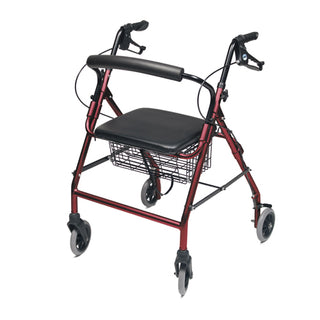
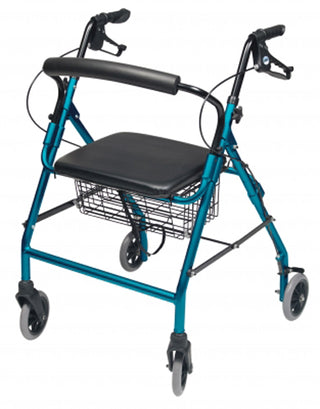
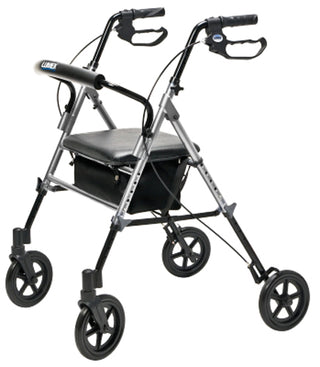
A four-wheel rollator is a rolling walker with hand brakes and a built-in seat, designed for users who can walk but need something to lean on and somewhere to rest. This collection carries 83 models spanning petite through tall and bariatric heights, with wheel sizes from 6 to 10 inches, plus pediatric gait trainers and rollator transport chair combinations.
The seat is why people choose a rollator, and it is also why a rollator is not simply a better walker. A rollator rolls freely on all four wheels. It does not stop when you lean on it; it stops when you pull the brakes. For a user with good hand function and reasonable balance, that trade is worth making because it removes the fatigue of lifting a frame and adds a place to sit when the legs give out. For a user who genuinely needs to put weight through the frame, or who cannot reliably operate brakes, it is the wrong equipment and the free-rolling behaviour is a hazard.
So the first question is not which rollator. It is whether a rollator is the right category at all. If the answer is yes, the specifications below are what separate one from another.
→ Part of Walkers & Rollators. Compare with Standard Walkers and Knee Walkers. Also see Canes & Crutches.
Getting the Handle Height Right
Handle height should place the handgrips at roughly wrist crease height when the user stands upright with arms relaxed, giving a slight elbow bend of about 15 to 30 degrees. Most rollators adjust within a range, but that range does not cover everyone, which is why height-specific models exist.
| Height Class | Suits | Example |
|---|---|---|
| Hemi | Shorter users, or where a lower handle is needed | Nitro Hemi |
| Petite | Smaller frame users | Escape Petite |
| Standard | The majority of adult users | AeroWalk standard height |
| Tall | Taller users; handle range extends higher | Nitro Sprint Tall, 32 to 39.4 inch handles |
A tall user on a standard rollator ends up stooping over it, which reintroduces exactly the forward-flexed posture the equipment should be preventing. The Nitro Sprint Tall reaches 39.4 inches and Rhythm's Tall Arpeggio and Nitro tall with 10 inch casters cover the same need. Rhythm's 807ADJBK adjusts from 18 to 22 inches at the seat, and their Royal Universal and Royal Deluxe Universal use a wider universal adjustment.
Wheel Size: 6, 8 or 10 Inch
Wheel size determines what the rollator can roll over. Six inch wheels suit smooth indoor floors, eight inch handles most outdoor pavement, and ten inch wheels manage grass, gravel and thresholds. This is the single specification most often got wrong, because rollators are usually tried indoors in a showroom and then used outdoors.
Small wheels catch on carpet edges, door thresholds, pavement cracks and drain covers. When a wheel stops suddenly and the user does not, that is a fall. If the rollator will be used outside at all, larger wheels are not a comfort upgrade.
- 6 inch: indoor use, tight spaces. Rhythm's Royal aluminium with 6 inch wheels and the Drive RTL10261 with 6 inch casters at 300 lb.
- 8 inch: the general-purpose choice. See the Arpeggio with 8 inch chrome wheels.
- 10 inch: outdoor and uneven ground. The Crescendo with 10 inch front wheels, the Rimor LT and the carbon fibre Opus.
Brakes: Loop, Push-Down and Slow-Down
Loop brakes squeeze like bicycle brakes to slow the rollator and push down to lock it in place. Push-down brakes lock when the user presses down on the handles, engaging automatically as weight is applied. The distinction matters for users with limited grip strength.
Loop brakes
The standard mechanism, giving control while walking and a positive lock for sitting. They need hand strength and coordination to operate. Rhythm's Royal Steel with locking loop brakes is a straightforward example.
Push-down brakes
These engage when the user leans on the handles, which suits a user with weak grip. The Clever Lite walker with seat and push-down brakes uses this system. The trade-off is less fine control of speed while walking.
Slow-down brakes for downhill control
A rollator can run away from a user on a slope, which is one of the more frightening things that happens with this equipment. Triumph's slow-down brake sets add continuous resistance rather than on-off braking: for the Escape and for the Maverick. If the user's route involves any real gradient, this is worth specifying.
Bariatric, Wide and Transport Combination Models
Bariatric and wide seat rollators
Bariatric rollators combine a higher weight rating with a wider seat and wider frame. Options include the Rhythm Regal bariatric, the bariatric Crescendo with 10 inch front wheels, the Dynarex bariatric HD, the Triumph Escape HD and the Imperial bariatric hemi at 450 lb. Wide-seat options without full bariatric rating include the Walkabout Wide and the Set N Go Wide.
Rollator transport chair combinations
A Duet-style unit works as a rollator when the user walks and converts to a transport chair when they cannot. That covers the common situation where someone manages short distances but needs pushing for longer ones, without carrying two pieces of equipment. See the Drive Duet in black, blue and burgundy.
Lightweight and carbon fibre
Where the rollator goes in a car regularly, frame weight decides how often it actually gets used. Carbon fibre options are the Nitro Elite CF and Rhythm's Opus. Lighter aluminium options include the AeroWalk Ultra Lite and the Drive RTL10288.
Pediatric Rollators and Gait Trainers
A gait trainer is not a small rollator. It provides trunk, hip and forearm support so a child can practise a walking pattern that they could not sustain unsupported, and it is prescribed as part of therapy rather than as a mobility aid.
The Drive Moxie and Trekker systems are built around modular support components. The base is the Moxie GT pediatric gait trainer in large, and the supports fit both Moxie and Trekker: forearm platforms small and large, hip positioner small and large, trunk support and thigh prompts. Which components a child needs is a therapy decision, and it changes as they progress.
Simpler pediatric rollators include the Drive Junior rollator and Clarke Healthcare's Marcy range in standard and telescoping versions.
Anterior safety rollers
Safety rollers add a frame that surrounds the user, used in rehabilitation where a fall risk exists during gait training. The adult anterior safety roller, the bariatric heavy duty version, plus adjustable forearm platforms and a width-adjustable seat.
Frequently Asked Questions
What is the difference between a walker and a rollator?
A walker has rubber tips or two front wheels and provides resistance when weight is applied to it. A rollator has four wheels that roll freely and stops only when the brakes are applied. A rollator suits a user who can walk but needs something to lean on and somewhere to rest; a walker suits a user who needs to put real weight through the frame. Choosing a rollator for a user who needs a walker removes the support they were relying on.
How do I set the handle height on a rollator?
With the user standing upright in their usual shoes and arms hanging relaxed, the handgrips should sit at about wrist crease height, giving roughly a 15 to 30 degree elbow bend when holding the handles. Set too low, the user stoops forward, which is the posture most associated with falls. Set too high, the shoulders lift and control is reduced. Confirm the setting with the prescribing therapist.
What wheel size do I need on a rollator?
Six inch wheels for smooth indoor floors, eight inch for general use including pavement, ten inch for grass, gravel and thresholds. This is the most commonly misjudged specification, because rollators are tried indoors and then used outside. Small wheels catch on carpet edges, door thresholds and pavement cracks, and a wheel that stops when the user does not is a fall.
What is the difference between loop brakes and push-down brakes?
Loop brakes squeeze like bicycle brakes to slow the rollator and push down to lock it, requiring hand strength and coordination. Push-down brakes engage when the user leans on the handles, which suits a user with weak grip but gives less fine control of speed. If grip strength is limited, push-down is worth considering; if it is adequate, loop brakes give better control.
Is it safe to sit on a rollator seat?
Only with the brakes locked, on level ground, and sitting facing away from the handles so the frame is behind you. Rollator seats are designed for brief rests during a walk, not for extended sitting, and they have no backrest on most models. A rollator seat should never be used as a transport chair with someone sitting on it while being pushed, unless the model is specifically a rollator transport chair combination designed for that use.
What is a rollator transport chair combination?
A combination unit functions as a rollator when the user walks and converts to a transport chair when they need to be pushed. It suits the common situation where someone manages short distances independently but needs pushing for longer ones, without requiring two separate pieces of equipment. The Drive Duet range covers this configuration.
What are slow-down brakes and do I need them?
Slow-down brake sets add continuous resistance rather than on-off braking, which stops the rollator running away downhill. A rollator gathering speed on a slope is one of the more dangerous situations with this equipment, particularly for a user whose grip tires quickly. If the regular route involves any real gradient, they are worth specifying.
What is the difference between a rollator and a gait trainer?
A rollator is a mobility aid for someone who can already walk. A gait trainer provides trunk, hip and forearm support so a user, most often a child, can practise a walking pattern they could not sustain unsupported. Gait trainers are prescribed as part of a therapy programme, and the support components are added or removed as the user progresses. They are not interchangeable with rollators.
How much weight can a rollator support?
Standard rollators are typically rated 250 to 350 lb, with bariatric models reaching 450 lb and above. The rating covers both leaning on the frame while walking and sitting on the seat. If the user is near the limit of a standard model, specify a bariatric frame, which also gives a wider seat and a wider overall frame.
Are rollators covered by insurance?
Rollators may be covered as durable medical equipment when medical necessity criteria are met and documented by the prescribing clinician, though coverage rules differ between walker and rollator categories and some configurations are treated differently from others. Requirements are set by the payer. Our Medicare Part B coverage guide is a starting point, and the clinician's documentation determines the outcome.
MediDepot Purchasing Advantages
- Price Match Guarantee: found the same model for less elsewhere? We will match the verified price.
- Equipment Financing: available on larger mobility equipment orders.
- Extended Warranty: available on qualifying items.
- Military Discount: available for qualifying military personnel, veterans and facilities.
- Request a Quote: height and wheel size guidance, gait trainer component questions, facility pricing.
Related Buying Guides
- 2026 Guide to Buying Mobility Aids
- How to Clean and Maintain Your Mobility Aid
- Medicare Part B Coverage for Mobility Aids
- Manual vs Electric Power Wheelchairs
- Physical Therapy Equipment by Condition
Browse Related Collections
- All Walkers & Rollators
- Standard Walkers
- Knee Walkers
- Canes & Crutches
- Transport Wheelchairs
- Manual Wheelchairs
- Mobility Scooters
- Pediatric Seating & Positioning
- Physical Therapy & Rehab
- All Mobility Aids