Stainless, Plastic and Locking Carts From 300 to 700 lb
This collection spans four cart families that share a form and little else: locking medical carts with drawers, plastic lab and bedside carts, open-shelf stainless steel utility carts rated 300 to 700 lb, and food service, tray delivery and linen carts. Lakeside supplies most of the stainless and food service range, TrippNT the plastic carts, with Harloff, Detecto, Capsa, Clinton, Lumex and MidCentral covering clinical configurations.
Because the range is broad, the useful starting question is not which cart but which job. A cart holding controlled drugs needs locking drawers and a rigid frame. A cart carrying reagents around a lab wants a chemically resistant plastic surface that will not corrode. A cart moving 500 lb of supplies down a corridor needs a rated stainless frame and casters sized for the load. These are not interchangeable, and the shelf-count specification that dominates product titles is usually the least important of them.
→ Part of Medical Carts. Also see Anesthesia Carts, Cabinets & Casework, Medical Stands and All Clinic & Exam Equipment.
Which Cart Family Fits the Job?
| Family | Construction | Use |
|---|---|---|
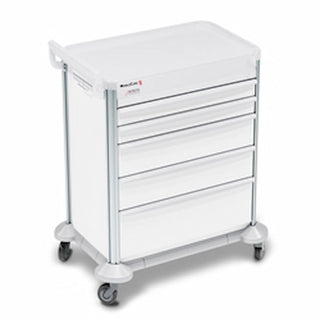
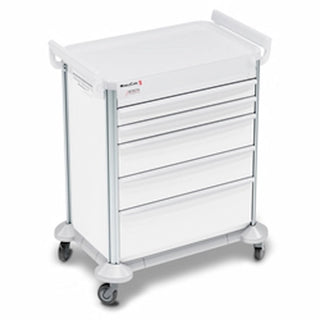
| Locking medical cart | Aluminum or steel, drawers | Medications, procedure supplies, intubation |
| Plastic lab cart | Moulded polymer, non-corroding | Reagents, lab transport, bedside supplies |
| Stainless utility cart | Open shelves, 300 to 700 lb | Bulk supplies, equipment transport, sterile processing |
| Food service and linen | Stainless or aluminum, specialised | Meal trays, sheet pans, hampers and linens |
Locking Medical Carts
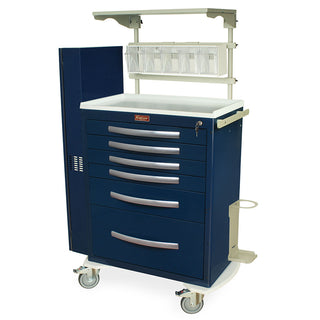
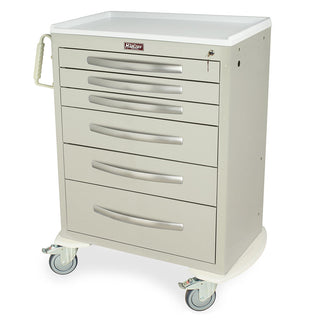
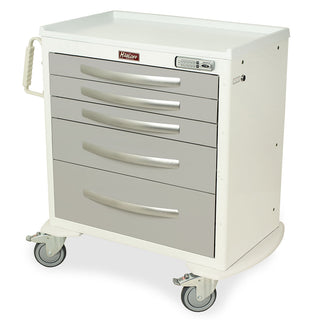
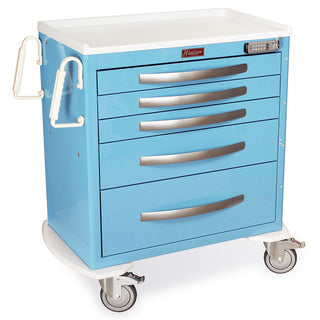
Where a cart holds medications or restricted supplies, drawer locking is a compliance requirement set by facility policy, not a feature choice. Harloff's A-Series aluminum carts carry the same lock coding as their anesthesia range: K for key, E for electronic, KC for auto-locking.
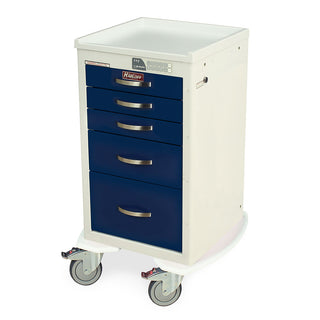
Options include the MPA3024E05 five-drawer, the MPA3027B06 six-drawer, the MPA3030K06, and for tight spaces the MPA1824EKC05 narrow cart with electronic auto-locking. The MPA3030K16 intubation cart is laid out for airway equipment specifically.
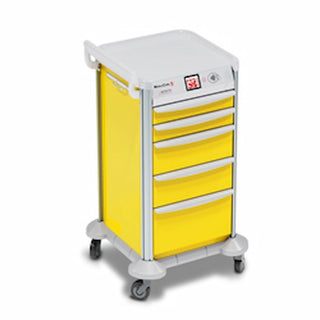
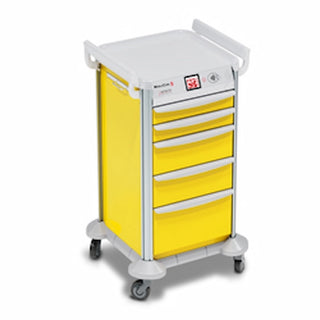
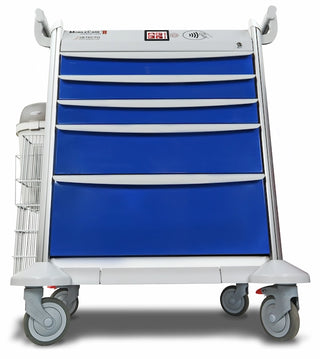
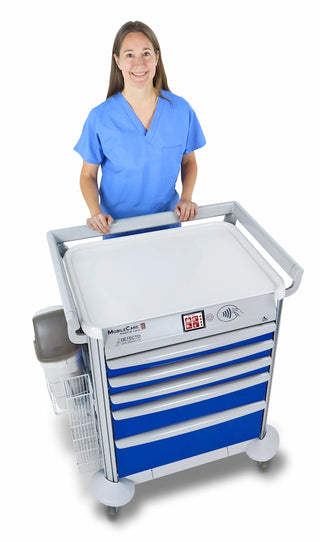
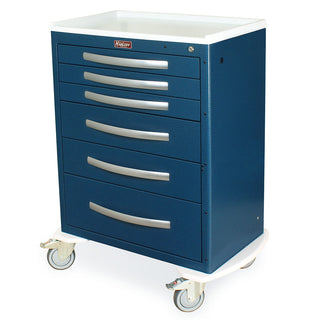
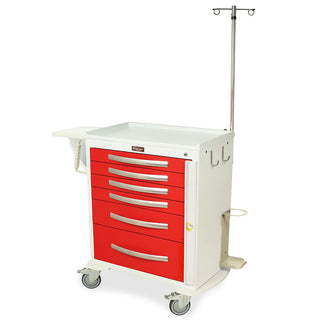
Detecto's MobileCare and Rescue series add electronic locking with drawer sensors: the MobileCare with electronic lock and drawer sensors, the five-drawer electronic cart, the 2023120 MobileCare, plus colour-coded emergency carts in the Rescue Series ER cart in red and the anesthesiology cart in blue. Drawer sensors matter because they record which drawer opened and when, which is the audit trail a lock alone does not give you.
Documentation and computing carts
The Capsa M38e healthcare computing workstation and the SlimCart ultra-lightweight documentation cart. In a ward where a cart is pushed room to room all shift, the weight of the cart is what staff actually notice, which is the SlimCart's argument.
Plastic Lab and Bedside Carts
Plastic carts do not corrode, which is the whole argument in a lab where spills are routine and reagents are aggressive. A stainless cart resists most chemistry but will pit and stain under repeated acid exposure; a moulded polymer cart will not.
TrippNT's range covers several layouts: the 510xx TL 6D tall slender six-drawer cart for narrow aisles, the 510xx compact four-drawer, the extra wide compact cart with four locking drawers, and the 535xx Core DX cart with sliding door and railtop. The 536xx equipment cart with adjustable shelf handles items of varying height, and the 54056 tall slanted suture cart with clear lockable door lets staff identify a suture without opening the door.
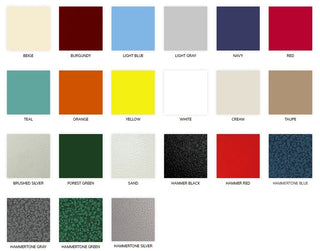
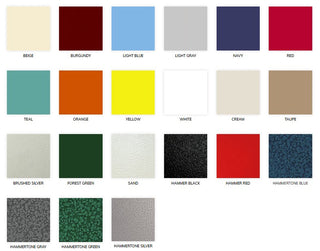
Lab island carts give a working surface as well as storage: the Belize lab island cart and the Maui lab island cart. For patient rooms, the TrippNT bedside cart in six colours and the Lakeside BV05 Super Saver bedside cart, available in two, three, four, five and six drawer versions.
Stainless Steel Utility Carts: Matching Capacity to Load
Lakeside's stainless range runs 300, 500 and 700 lb, and the rating covers frame, shelves and casters together. Overloading a 300 lb cart does not usually break a shelf, it destroys the casters, and a cart with a seized caster is harder to push than a heavier cart that rolls properly.
- 300 lb: the 311 at 15.5 x 24 and the 322 at 18 x 27, both three-shelf.
- 500 lb: the 411, the 422, the larger 444 at 21 x 35 and the chrome-plated tubular 492.
- 700 lb heavy duty: the 711, the 743 two-shelf and the 744 three-shelf.
Ergonomic handles
The Handler Series 4322 with ergonomic handle and the Ergo-One System 6600 address a real injury pattern: pushing a loaded cart with a poorly positioned handle loads the shoulders and lower back, and staff do it dozens of times a shift. Where carts are in constant use, the handle design is worth the difference.
Also stocked: the MidCentral CRT30008 stainless utility carts, the Lakeside 610 enclosed bussing cart and the Lakeside dunnage rack at 2000 lb for floor-level bulk storage.
Clinical Specialty Carts
Clinton's Cart-Mate range combines cabinet storage with a cart footprint in 48 inch, 60 inch and 72 inch widths. Their phlebotomy carts come as a one-bin 67100 and a two-bin 67200.
Purpose-specific carts: the MidCentral OTA148 stirrup cart, the Pegasus hemodialysis support trolley with accessories, the SRScales pediatric cart and scale table, the O2 Concepts pull cart for the OxLife Liberty2, and the Spill Magic 97519 spill kit cart. Bailey's therapy carts hold cuff weights: the 783 small at 27 inches and the 784 large at 42 inches, 400 lb.
Linen and hamper carts
The Lumex 8510 multi-bag hamper cart in single and double bag models, the 8523 multi-shelf linen cart in two, three and four shelf versions, and the 8520 small multi-purpose equipment cart.
Food Service and Tray Delivery
This collection also carries NSF-rated food service carts for hospital and facility dining, which are a distinct product line from clinical carts despite the shared shelf-and-caster form.
Meal delivery: the 159518 Lunch Time meal transport cart with double-sided slanted shelves, the 551 aluminum tray delivery cart at 20 trays, the 437 late tray delivery cart and the 179 tray rack.
Kitchen equipment: sheet pan racks including the 129 with channel ledges, the 137 with angle ledges, the 157, the 162, the 172 and the 183, plus a 620 mobile sheet pan dolly. Also the 110 mobile wing table, the 146 mise en place cart, the 296 beverage bin, plastic utility carts in 2000 and 2500 dual handle versions, and a 09917 indicator light.
Frequently Asked Questions
Should I choose a stainless steel or plastic cart?
Stainless suits heavy loads, high heat and general clinical transport, and it takes aggressive cleaning. Plastic does not corrode, which is the deciding factor in a lab where spills are routine and reagents are aggressive: stainless resists most chemistry but pits and stains under repeated acid exposure. Plastic carts are also lighter and quieter to push. For load capacity above roughly 300 lb, stainless is the practical choice.
What does a 300, 500 or 700 lb cart rating cover?
The rating applies to the frame, shelves and casters together, distributed across the shelves rather than loaded on one. Overloading usually destroys the casters rather than breaking a shelf, and a cart with a seized caster is harder to push than a heavier cart that rolls properly, so the practical consequence of over-specifying the load is a cart nobody wants to use. Size to your heaviest routine load with margin.
Do I need locking drawers?
If the cart holds medications, controlled substances or restricted supplies, yes, and the requirement is set by your facility policy rather than by preference. Lock types run from key, through auto-locking that relocks itself after an interval, to electronic access with an audit trail. Some carts add drawer sensors, which record which drawer opened and when, providing documentation that a lock alone does not.
Why do emergency carts come in specific colours?
Colour coding lets staff identify the right cart instantly in a situation where hesitation costs time, typically red for emergency and resuscitation and blue for anesthesiology. It is a workflow feature, not decoration. If your facility already uses a colour scheme, match new carts to it rather than introducing another convention.
Are ergonomic handles worth the extra cost?
Where carts are pushed constantly, yes. Pushing a loaded cart with a poorly positioned handle loads the shoulders and lower back, and staff repeat that movement dozens of times a shift. Handle height and grip angle determine whether the force goes through the legs or the spine. For an occasionally used cart it matters little; for a cart in constant service it addresses a genuine injury pattern.
What is a lab island cart?
A cart with a working surface as well as storage, so it functions as a mobile bench rather than only as transport. It suits labs where bench space is the constraint and a task needs a temporary surface near where the work is happening. The trade-off is footprint, since a cart used as a work surface stays in one place more often than a transport cart does.
Can I use a food service cart for clinical supplies?
For general non-sterile supply transport, an NSF-rated stainless cart is often perfectly suitable, since the construction and cleanability standards are high. What it does not provide is locking, drawer organisation, or the specific layouts clinical carts offer. Do not substitute a food service cart where locking or documented access is required.
What does NSF certification mean on a cart?
NSF certification indicates the cart meets standards for commercial food service equipment covering construction, materials and cleanability. It is a food service standard, so it tells you the cart is suitable for a commercial kitchen or dining operation. It is not a clinical or laboratory standard and should not be read as one.
How do I choose cart dimensions?
Measure the narrowest doorway, corridor turn and lift the cart must pass through, then work backwards to a shelf size. A cart that carries everything but cannot turn a corner is worse than a smaller one that goes where it is needed. Also check overall height against any shelf or fixture it must pass under, which is the dimension people most often forget.
Do utility carts arrive assembled?
Locking medical carts generally arrive assembled on a pallet by freight. Open-shelf stainless carts and sheet pan racks often ship knocked down and require assembly, which is straightforward but takes time if you are building several. Product pages note assembly requirements. For a multi-cart order, request a quote so freight can be consolidated.
MediDepot Purchasing Advantages
- Price Match Guarantee: found the same model number for less elsewhere? We will match the verified price.
- Equipment Financing: available on multi-cart departmental orders.
- Extended Warranty: coverage on locking mechanisms, casters and drawer slides.
- Military Discount: available for qualifying military medical facilities and personnel.
- Request a Quote: load and dimension matching, lock type confirmation, colour coding and freight consolidation.
Related Buying Guides
- Physician Office Setup Checklist
- Private Practice Equipment Buying Mistakes
- Clinic Infection Control Supplies Checklist
- Medical Equipment Quote Comparison Checklist