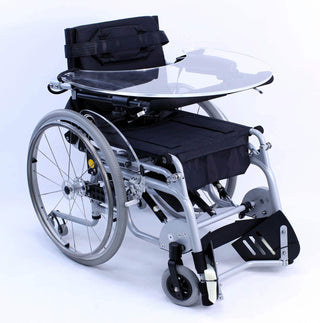
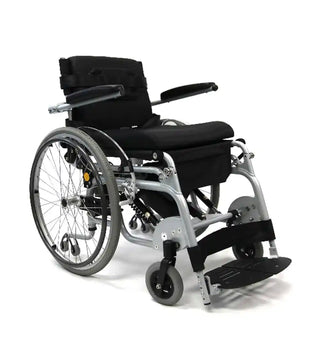
Folding Manual Wheelchairs in 16 to 24 Inch Seat Widths
A standard manual wheelchair is a folding steel or aluminium frame chair, typically weighing 35 to 45 lb, rated around 250 to 300 lb, and specified primarily by seat width, arm style and legrest style. This collection carries chairs from Drive Medical, Drive DeVilbiss, Ki Mobility, Karman, Everest & Jennings, Proactive Medical and Dynarex across the full range of those configurations.
Almost every wheelchair problem people bring to us traces back to one decision made badly at the start: the seat width. Too narrow and the user is compressed at the hips, which causes pressure at the trochanters and makes a long sitting session genuinely painful. Too wide and they slide sideways, lose the postural support of the side panels, and reach further to push the rims, which wrecks shoulders over time.
So before comparing anything else, measure. Sit the person on a firm surface, measure the widest point across the hips or thighs, and add about two inches total for clearance. That number is your seat width. Everything else on this page assumes you have it.
→ Part of Manual Wheelchairs. Compare with Lightweight Wheelchairs, Transport Wheelchairs and Bariatric Wheelchairs.
How Do I Choose the Right Wheelchair Seat Width?
Measure the widest point across the seated user's hips and thighs, then add roughly two inches total, about one inch of clearance on each side. Standard seat widths run 16, 18, 20, 22 and 24 inches, and the 18 inch width fits the largest share of adult users.
| Seat Width | Typical Hip Measurement | Common Use |
|---|---|---|
| 16 inch | Around 14 inches | Smaller adults, adolescents, narrow doorway environments |
| 18 inch | Around 16 inches | The most commonly specified adult width |
| 20 inch | Around 18 inches | Larger adults, users who need extra room for clothing or padding |
| 22 to 24 inch | 20 inches and above | Heavy duty configurations; see Bariatric Wheelchairs |
Two things that catch people out. First, measure with the clothing the person actually wears, including a coat if the chair goes outdoors in winter. Second, check your doorways: overall chair width runs roughly eight inches wider than the seat, so a 20 inch seat produces a chair around 28 inches wide, and standard interior doors are not always as generous as they look.
Desk Arms or Full Arms?
Desk arms are cut lower at the front so the chair can pull up to a table or desk. Full arms run the full seat length and give more forearm support. Both are available fixed, detachable or height-adjustable, and the detachable versions matter enormously for transfers.
Desk arms
Choose desk arms if the user eats at a table, works at a desk or spends time at any surface they need to get close to. The cutaway lets the chair slide under, which sounds minor until you watch someone try to eat a meal at arm's length from the table. Options include the Drive Cruiser III range in 16 inch, 18 inch and 20 inch seat widths with detachable desk arms.
Full arms
Full-length arms give better support for a user who leans on the armrests to reposition or who spends long periods in the chair without needing table access.
Detachable and height-adjustable
A detachable arm comes off, opening the side of the chair for a lateral slide transfer to a bed or another seat. If the user does board transfers or is assisted in and out of the chair, this is not optional, it is the difference between sliding across and being lifted over an obstacle. Height-adjustable arms let you set forearm support correctly for the individual rather than accepting a fixed height, as on the Proactive Chariot III with removable adjustable-height arms.
Swing-Away Footrests or Elevating Legrests?
Swing-away footrests pivot out of the way for transfers and standing. Elevating legrests do that too and additionally raise the leg toward horizontal, which is a clinical feature rather than a comfort one.
When elevating legrests are indicated
- Lower limb oedema, where elevation assists venous return.
- A knee that cannot flex to 90 degrees, from contracture, a cast or post-surgical restriction.
- A care plan that specifies leg elevation during seated periods.
Elevating legrests add weight, add length to the chair and cost more, so they are not a default upgrade. If the user has no clinical reason to elevate, swing-away footrests are lighter, shorter and easier to live with.
Most chairs in this collection are offered both ways. The Drive Cruiser III and Cruiser X4 lines carry ELR and SF suffixes on the model number for exactly this: the Cruiser X4 with 16 inch seat, elevating legrest and desk arm and the 20 inch version offered with either. Legrests are also available separately: Karman's EL-S115 elevating legrest comes in 16, 18 and 20 inch widths.
Hemi Height Chairs for Foot Propulsion
A hemi wheelchair has a lower seat-to-floor height, typically around 17 to 17.5 inches instead of the standard 19.5 inches, so the user can reach the floor and propel with one or both feet. The name comes from hemiplegia, where one arm may not be usable for pushing, but the configuration suits anyone who propels with their feet.
This is a commonly missed specification. A user who cannot reach the floor in a standard chair loses the ability to move themselves at all and becomes dependent on being pushed. Lowering the seat by two inches restores their independence. Options include the Drive Nitro Sprint Hemi in a folding aluminium frame at 350 lb and the Proactive Chariot II standard hemi.
Tilt-in-Space and Complex Rehab Chairs
A tilt-in-space wheelchair rotates the whole seat and back as a unit, keeping hip and knee angles fixed while shifting pressure from the seat to the back. That is a pressure injury prevention and postural management feature, and it is the reason these chairs appear in complex rehab specifications rather than as a comfort option.
Ki Mobility's range covers this: the CR45 with 45 degrees of tilt, the Focus CR complex rotation tilt chair and the Liberty folding tilt wheelchair. Their Catalyst 4 and Catalyst 4C cover the high-strength lightweight category.
Complex rehab seating usually needs positioning components alongside the chair. Ki Mobility Axiom backs in 14 to 22 inch widths, custom backs at 12 to 22 inch heights, pelvic belts such as the padded centre-pull two-point belt and chest supports are all stocked here. More in Wheelchair Accessories and Wheelchair Cushions.
Compare Standard Wheelchair Configurations
| Model | Seat Width | Configuration | Best Fit |
|---|---|---|---|
| Drive Cruiser III K318DDA | 18 inch | Detachable desk arm, ELR or swing-away | The default adult configuration |
| Drive Cruiser X4 CX416 | 16 inch | Desk or full arm, 300 lb capacity | Smaller users, lighter aluminium frame |
| Drive Nitro Sprint Hemi | Standard | Hemi height, folding aluminium, 350 lb | Users who propel with their feet |
| E&J Traveler SE Plus | Standard | 300 lb capacity, nylon or vinyl | General daily use, upholstery choice |
| E&J Traveler HD | Standard | Heavy duty frame, vinyl | Higher weight or heavier daily use |
| Proactive Chariot III K3 | 16 inch | Removable adjustable-height arms | Users needing arm height set individually |
| Ki Mobility Catalyst 4 | Configurable | K0004 high strength lightweight | Active full-time users |
| Ki Mobility Liberty | Configurable | Folding tilt-in-space | Pressure management with transport folding |
| Drive Sentra STD20DDA | 20 inch | Extra heavy duty, ELR, 500 lb | Higher capacity in a standard-style chair |
| Dynarex DynaRide S5 Ultra Lite | Standard | Ultra lightweight frame | Frequent lifting into a vehicle |
Frequently Asked Questions
How do I measure for a wheelchair seat width?
Seat the person on a firm surface, measure across the widest point of the hips or thighs, and add about two inches in total for clearance. Measure with the clothing they will actually wear, including outerwear if the chair is used outdoors. A width that is too narrow causes pressure at the hips; one that is too wide lets the user slide sideways and forces a longer reach to the push rims, which loads the shoulders.
What is the difference between desk arms and full arms?
Desk arms are cut lower at the front so the chair can pull up to a table or desk. Full arms run the full seat length and give more forearm support for a user who leans on the armrests. Choose desk arms if the user eats at a table or works at a desk, full arms if they spend long periods seated without needing surface access.
Should I get swing-away footrests or elevating legrests?
Swing-away footrests pivot aside for transfers and standing. Elevating legrests do that as well and additionally raise the leg toward horizontal, which is indicated for lower limb oedema, a knee that cannot flex to 90 degrees, or a care plan specifying elevation. Elevating legrests add weight, length and cost, so they should follow a clinical reason rather than being treated as an upgrade.
What is a hemi wheelchair?
A hemi wheelchair has a lower seat-to-floor height, typically around 17 to 17.5 inches rather than the standard 19.5 inches, so the user can reach the floor and propel with one or both feet. It is specified for users who self-propel with their feet, including many people after a stroke. A user who cannot reach the floor in a standard chair loses the ability to move independently, so this is a significant specification rather than a minor one.
Why do detachable armrests matter?
A detachable arm comes off so the side of the chair opens, allowing a lateral slide transfer to a bed, toilet or car seat instead of lifting the user over a fixed armrest. If the user does board transfers or is assisted in and out of the chair, detachable arms directly reduce injury risk for both the user and whoever is assisting.
What do K-codes such as K0001 and K0004 mean?
K-codes are HCPCS billing codes used in the United States that group manual wheelchairs by category: broadly, K0001 standard, K0002 standard hemi, K0003 lightweight, K0004 high strength lightweight, and higher codes for heavy duty and custom configurations. Each code has its own coverage criteria and documentation requirements set by the payer. If reimbursement matters, confirm the code with the prescribing clinician and the payer before purchase, since the code determines what is covered.
What is tilt-in-space and who needs it?
A tilt-in-space chair rotates the seat and back together as one unit, so hip and knee angles stay fixed while pressure shifts from the seat toward the back. It is used for pressure injury prevention and postural management in users who cannot reposition themselves. It is a clinical prescription rather than a comfort upgrade, and chair and seating should be specified together by a seating clinician.
How wide will the chair be overall?
Overall width typically runs around eight inches wider than the seat width, so an 18 inch seat gives roughly a 26 inch overall chair and a 20 inch seat roughly 28 inches. Measure your narrowest doorway, bathroom entry and any corridor turn before ordering. This is a routine and avoidable problem, and it is easier to check with a tape measure than to discover after delivery.
How much does a standard wheelchair weigh?
Standard steel-frame chairs generally weigh 35 to 45 lb with footrests attached. If the chair is going to be lifted into a car boot regularly, that weight is the constraint that matters most, and the lightweight range is worth looking at instead. Removing the legrests takes several pounds off the lift, which is worth knowing regardless of which chair you choose.
Does the wheelchair come with a cushion?
Generally not. A standard chair has a sling seat, which does not provide pressure redistribution for extended sitting. Anyone spending more than short periods in the chair should have a cushion selected for their risk level. See Wheelchair Cushions, and for users at higher pressure injury risk this should follow a clinical assessment rather than a general choice.
MediDepot Purchasing Advantages
- Price Match Guarantee: found the same model and configuration for less elsewhere? We will match the verified price.
- Equipment Financing: available on chairs, seating and accessories ordered together.
- Extended Warranty: coverage beyond the manufacturer term on daily-use chairs.
- Military Discount: available for qualifying military personnel, veterans and facilities.
- Request a Quote: seat width and configuration guidance, facility fleet pricing and accessory matching.
Related Buying Guides
- Manual Wheelchair Sizing Guide: Seat Width, Depth and Footrest Height
- Manual vs Electric Power Wheelchairs
- 2026 Guide to Buying Mobility Aids
- Medicare Part B Coverage for Mobility Aids
- How to Clean and Maintain Your Mobility Aid
- Sit-to-Stand vs Hoyer Lift: Safety and Staffing
Browse Related Collections
- All Manual Wheelchairs
- Lightweight Wheelchairs
- Transport Wheelchairs
- Bariatric Wheelchairs
- Power & Electric Wheelchairs
- Wheelchair Cushions
- Wheelchair Accessories
- Walkers & Rollators
- Canes & Crutches
- Patient Lifts & Transfer Systems
- All Mobility Aids