


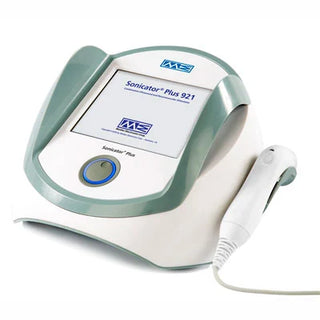


Sonicator Units, 1 and 3 MHz Applicators and Combination Systems
Therapeutic ultrasound delivers acoustic energy into tissue through a transducer head, producing thermal and non-thermal effects at a depth determined by the frequency. This collection is built around the Mettler Electronics Sonicator range, with applicators from 1 cm² to 10 cm² at 1 MHz and 3 MHz, combination units pairing ultrasound with electrical stimulation, diathermy systems, radial pressure pulse therapy and the couplant gel every treatment requires.
Two physical facts govern everything on this page. Frequency determines depth, inversely: lower frequency penetrates further. And ultrasound does not cross air, which is why the couplant is not an accessory but a functional requirement, and why an applicator lifted a millimetre off the skin delivers essentially nothing.
→ Part of TENS & Electrotherapy. Also see TENS Units, Electrodes & Supplies, Pain Management and Laser & Light Therapy.
1 MHz or 3 MHz? Frequency Sets the Depth
Lower frequency penetrates deeper because it is absorbed more slowly by tissue; higher frequency is absorbed faster and therefore deposits its energy more superficially. That relationship is the single most useful thing to understand about selecting an applicator.
| Frequency | Energy deposited | Generally selected for |
|---|---|---|
| 1 MHz | Deeper tissue | Structures under a thicker soft tissue layer |
| 3 MHz | More superficial tissue | Structures close to the surface |
The practical consequence: using 1 MHz on a superficial target sends much of the energy past it, and using 3 MHz on a deep target deposits the energy in the tissue above. Neither is dangerous in the usual case, but neither treats what was intended.
Dual-frequency applicators cover both from one head, which suits a clinic treating varied presentations without swapping applicators between patients: the Mettler 7413 ME-740 dual frequency applicator, 5 cm² at 1 and 3 MHz. Single-frequency options include the 7410 at 10 cm², 1 MHz, the 7305 at 5 cm², 1 MHz and the ME-740 applicator at 1 cm², 3.3 MHz.
Applicator Size and Effective Radiating Area
Applicator size is quoted as effective radiating area, the portion of the head that actually emits ultrasound, and it should be matched to the treatment area rather than to the body part.
A common guide is that the treatment area should be roughly two to three times the ERA, because the applicator must keep moving throughout the session and needs somewhere to move within. Too large an applicator on a small area means it cannot move without leaving the target; too small an applicator on a large area means the session takes proportionally longer to cover it.
The sizes stocked reflect that range: 1 cm² for small joints and confined areas such as the hand and foot, 5 cm² as the general-purpose size, and 10 cm² for larger regions such as the back and thigh.
Combined ultrasound and IASTM heads
Some applicators integrate an instrument-assisted soft tissue mobilisation tool, allowing manual soft tissue work and ultrasound in one head: the Mettler 7402 SoniTool 5 cm² IASTM attachment and the 7413T dual frequency applicator with IASTM tool and O-ring.
Cables
Applicator cables flex constantly during treatment and are a wear item rather than a permanent part: the 7391 universal applicator cable for the Sonicator series and the 7392 hooded universal cable.
Couplant: Why the Gel Is Not Optional
Ultrasound does not transmit through air. Without a couplant filling the space between the transducer face and the skin, essentially none of the energy enters the tissue, and it reflects back into the applicator instead.
That has two consequences worth knowing. The treatment does nothing, and the reflected energy heats the transducer head, which over time is how applicators are damaged. An applicator run against air rather than skin is being cooked by its own output.
Practical points: apply enough gel that the head glides without pressure changes, keep the whole face in contact throughout, and top up if the gel dries or is displaced during a long session. Air bubbles trapped in the gel are small dead zones for the same reason.
Couplant options: Mettler Sonigel couplant gel in 5 L bottles, 4-pack master case, Sonigel ultrasound and massage lotion in 1 gallon and 4 gallon master pack, and Spectra 360 conductive gel in 250 gram tubes. Bulk sizing matters here because couplant is consumed steadily and running out mid-clinic stops treatment entirely.
Combination Units: Ultrasound Plus Stimulation
Combination units house therapeutic ultrasound and electrical stimulation in one device, so a clinic delivers both modalities from a single machine and, on some units, simultaneously through the same applicator.
The argument for combination is floor space and workflow rather than clinical superiority. A treatment room has limited surface, and a two-channel or four-channel combination unit replaces two devices and two carts. Channel count determines how many stimulation circuits run independently, which sets how many patients or sites can be treated at once.
- The Mettler ME-921 Sonicator Plus 921, two channel with touch screen, and the ME-921C with cart.
- The ME-941 Sonicator Plus 941, four channel combination stimulator with ultrasound, and the ME-941C with cart.
- Synchrosonic combo with ultrasound and dual low volt AC stim and with high volt stim.
Applicators for the Plus range: the Sonicator Plus applicator, 5 cm² at 1.0 and 3.2 MHz.
Ultrasound-only units
Where stimulation is delivered separately: the Mettler ME-740 Series Sonicator 740 therapeutic ultrasound and the Sonicator 740X with 3 cm standard applicator.
Dedicated stimulators
The Sys-Stim range covers neuromuscular stimulation as separate units: the ME-206 Sys-Stim 206, the ME-208A two channel low volt device, the ME-228 Sys-Stim 228 two channel multifunction and the ME-240 Sys-Stim.
Diathermy and Radial Pressure Pulse
Shortwave diathermy
Diathermy uses electromagnetic energy rather than acoustic energy, delivering heating over a larger volume than an ultrasound head can cover. The Mettler ME-391 Auto-Therm 391 with drum arm and chart and the TheraTouch DX2 shortwave diathermy cover this modality.
Auto-Therm accessories are stocked separately, which matters because these are the parts that fail or get damaged: the 3985 14 cm induction coil applicator head with cable, the 3987 multi-joint articulated arm, coaxial cables for the drum applicator and the coil applicator, the 3984 securing strap for the 14 cm drum, the 3974 neon check light tester and the 96 mobile workstation cabinet.
Radial pressure pulse therapy
The Mettler ME-695 Auto Wave radial pressure pulse therapy device delivers mechanical pressure pulses rather than continuous acoustic energy. Transmitter diameter changes the area and focus of the pulse: 15 mm, 20 mm and 36 mm kit, plus the 69501 handpiece applicator and the 69518 point locator and trigger point handpiece.
Carts, Cleaning and Clinic Support
Treatment carts put the unit, applicators and gel at the treatment position: the Sonicator treatment cart for the ME-921 and ME-941 and a 73 three-shelf mobile therapy cart in light grey.
Mettler ultrasonic cleaners for instrument reprocessing are also stocked here, in 3 L, 6 L, 10 L, 22 L and 20 gallon sizes, all with basket, cover and adjustable heater. See Instrument Cleaning for the reprocessing context.
Also here: DuraPak reusable hot and cold gel therapy packs, ThermalSoft Pro back therapy set with cover and straps, the MR Cube monitored rehab device with laptop, and Fluidotherapy units at 110D and 115D. Applicator storage: a hard protective carrying case.
Frequently Asked Questions
What is the difference between 1 MHz and 3 MHz therapeutic ultrasound?
Frequency determines depth inversely: 1 MHz is absorbed more slowly and penetrates deeper, while 3 MHz is absorbed faster and deposits energy more superficially. Using 1 MHz on a superficial target sends much of the energy past it; using 3 MHz on a deep target deposits it in the tissue above. Dual-frequency applicators cover both from one head, which suits clinics treating varied presentations.
Why does therapeutic ultrasound need coupling gel?
Ultrasound does not transmit through air. Without a couplant filling the space between the transducer face and the skin, essentially no energy enters the tissue and it reflects back into the applicator instead. That means the treatment does nothing, and the reflected energy heats the transducer head, which over time damages applicators. Gel is a functional requirement rather than an accessory.
What happens if the applicator lifts off the skin?
Transmission stops almost entirely, because even a thin air gap blocks the acoustic energy. The applicator continues emitting into that gap and the reflected energy heats the head. Keeping the whole transducer face in contact throughout, using enough gel that the head glides without pressure changes, and topping up during long sessions all address the same problem. Air bubbles trapped in the gel are small dead zones for the same reason.
How do I choose applicator size?
Match the effective radiating area to the treatment area rather than to the body part. A common guide is that the treatment area should be roughly two to three times the ERA, because the applicator must keep moving throughout the session and needs room to move within. A 1 cm² head suits small joints such as the hand and foot, 5 cm² is the general-purpose size, and 10 cm² suits larger regions like the back and thigh.
Why must the applicator keep moving during treatment?
Because a stationary head concentrates energy in one spot, and the intensity distribution across a transducer face is not perfectly uniform. Continuous movement distributes the energy across the treatment area and avoids localised concentration. This is why applicator size is chosen against the area available to move within rather than simply the largest head that fits.
What does a combination unit add?
It houses therapeutic ultrasound and electrical stimulation in one device, so a clinic delivers both from one machine and, on some units, simultaneously through the same applicator. The argument is floor space and workflow rather than clinical superiority: a treatment room has limited surface, and a combination unit replaces two devices and two carts. Channel count sets how many stimulation circuits run independently.
How many stimulation channels do I need?
Channel count determines how many independent stimulation circuits run at once, which sets how many sites or patients can be treated simultaneously. Two channels suit a single patient with one or two sites. Four channels suit either a patient needing several sites treated together or a clinic running more than one patient on the same device. Match it to how the room is actually used rather than to the higher specification.
What is the difference between ultrasound and shortwave diathermy?
Ultrasound delivers acoustic energy through a transducer head in contact with the skin, treating a relatively small area at a time. Shortwave diathermy uses electromagnetic energy through a drum or coil applicator and heats a larger tissue volume without the same contact requirement. They are distinct modalities with different indications, contraindications and application techniques rather than alternatives.
What does transmitter diameter change on a radial pressure pulse device?
It changes the area over which the pulse is delivered and how concentrated it is. A smaller transmitter focuses the pulse on a more confined area; a larger one spreads it over a wider region. Transmitter selection is therefore a treatment parameter, and devices are supplied with several sizes because different presentations call for different coverage.
Do applicator cables need replacing?
Yes. Cables flex constantly during treatment, since the applicator is moved throughout every session, and that flexing eventually breaks conductors inside the sheath. They are a wear item rather than a permanent part, and intermittent output or a unit that works in one cable position but not another usually indicates the cable rather than the applicator or the machine.
MediDepot Purchasing Advantages
- Price Match Guarantee: found the same model number for less elsewhere? We will match the verified price.
- Equipment Financing: combination units and diathermy systems are capital items; financing spreads the cost.
- Extended Warranty: coverage on transducers and control systems beyond the manufacturer term.
- Military Discount: available for qualifying military medical facilities and personnel.
- Request a Quote: applicator matching to your unit, couplant standing orders and cart pairing.
Related Buying Guides
- Physical Therapy Equipment by Condition
- Private Practice Equipment Buying Mistakes
- Physician Office Setup Checklist
- Medical Equipment Quote Comparison Checklist