Gait Training, Standing Frames and Pediatric Positioning
This collection covers the large equipment that rehabilitation happens on rather than with: parallel bars for supported gait, training stairs and ramps for real-world obstacles, standing frames for people who cannot stand unaided, and pediatric positioning seating. Brands include Bailey Manufacturing, SkillBuilders, Clinton Industries, Drive Medical, R82, Healthy You and Stroops.
What links these categories is that each one recreates a demand the patient will meet outside the clinic. Parallel bars give a controlled version of walking. Training stairs and curbs give a controlled version of the step at their front door. Standing frames give a controlled version of being upright, which the body needs for reasons that have nothing to do with walking anywhere.
→ Part of Physical Therapy & Rehab. Also see Standing Frames & Parallel Bars, Balance & Gait Training, Pediatric Seating & Positioning and PT Treatment Tables.
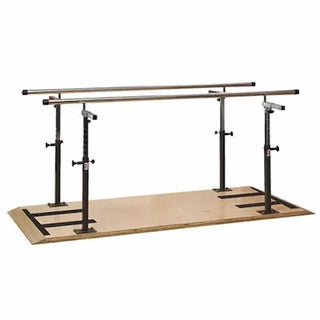
Parallel Bars: Floor, Platform, Wall or Folding?
The mounting decision is effectively permanent and it determines what the bars can be used for, so it deserves more thought than the length does.
| Mounting | Surface | Suits |
|---|---|---|
| Floor mounted | Patient walks on the room floor | Permanent gait areas; no step up to negotiate |
| Platform mounted | Patient walks on a raised platform | Installations where floor fixing is not possible |
| Wall mounted folding | Room floor, bars fold away | Rooms that must serve more than one purpose |
The platform is the trade-off worth understanding. A platform-mounted set needs no floor fixing and can be relocated, but the patient has to step up onto it, which is exactly the task some of them cannot yet do. Floor-mounted bars put the patient on the same level they will walk on outside.
Floor mounted: the Bailey 510 series in 10 through 24 ft lengths, the Clinton 34012 at 12 ft and Clinton floor mounted at 10 ft. Platform mounted: the Bailey 530/532 series in fixed width at 10 or 12 ft, the Bailey 540 series at 7, 10 and 12 ft, the Clinton 32007 and platform mounted bars at 12 ft.
Folding and space-saving
Where the room has to do other work between gait sessions: the Bailey 595 wall-mounted folding bars, height adjustable 28 to 42 inches, the Bailey 597/598 folding bars for adult or child, the Bailey 95-10 space saver with 26 to 44 inch height adjustment, the Clinton 33307 wall mounted folding and the Clinton 33310 folding at 10 ft.
Hemiplegic bars
The Bailey 577/580/582/590 hemiplegic parallel bars, floor mounted are configured for a patient who can use only one side. Standard bars assume two working arms; a patient with hemiplegia has one, and a set designed around that changes what they can practise independently rather than requiring a therapist to substitute for the absent side.
Bariatric and pediatric
The Bailey 4530 bariatric 10 ft bars at 500 lb and bariatric parallel bars at 10 ft. For small children, the Bailey 596 toddler folding parallel bars, and the 94A/94F child's handrail attachment adapts adult bars to a child's height.
Training Stairs, Curbs and Ramps
Walking on level ground and negotiating a step are different motor tasks, and a patient who has recovered one has not necessarily recovered the other. Training stairs exist because the step at someone's front door is what determines whether they can get home.
Configuration matters more than it appears. A one-sided staircase gives ascent and descent in one direction; a convertible set reconfigures between arrangements; a three-sided set lets a patient approach from different directions, which matters because turning at the top of stairs is its own difficulty. Handrail height and step rise are the parameters that make practice match the environment the patient is returning to.
- Convertible: the Bailey 805/806/807 convertible training stairs at 24 inches, 500 lb, the Bailey 815 ADA convertible at 36 inches wide and the Clinton 4-5080 convertible staircase.
- Three-sided and standard: the Bailey 808 three-sided at 30 inches wide, the Bailey 809 at 30 inches and the Bailey 810 at 36 inches.
- One-sided and small: the Clinton 4-5501 one-sided staircase, the adjustable one-sided 4-6501, the 4-5500 small up-down staircase and the adjustable small staircase 4-6500.
- Bariatric: the Bailey 4535 bariatric training stairs at 1000 lb, 48 inches wide.
Curbs and ramps
The Bailey 715 curb and ramp training set with a 44 x 84 inch ramp platform covers the two obstacles that stairs do not: the kerb at a road crossing, and the gradient of a ramp, which is a distinct challenge for both walking patients and wheelchair users learning to manage a slope.
Standing Frames
A standing frame supports a person in an upright position who cannot achieve or maintain it themselves, and the reasons for standing go well beyond preparing to walk.
Being upright loads bone, changes how the bladder and bowel sit and function, stretches hip and knee flexors that shorten in prolonged sitting, and alters respiratory mechanics. For a full-time wheelchair user, particularly a child, standing programmes are prescribed for those reasons rather than as walking practice. Frames are often used for scheduled periods rather than as a step toward ambulation.
Prone or supine
A prone stander supports the person from the front, leaning them forward into the frame, which leaves the arms free in front and suits a child who can control their head and wants to use their hands. A supine stander supports from behind and can start from a reclined angle, which suits someone with less head and trunk control who needs the frame to bring them up gradually. Multi-position frames do both.
R82's pediatric range covers the spread: the Caribou multi-position frame with prone and supine positions, 220.4 lb capacity, the Gazelle PS foldable multi-position stander in 3 sizes, the Rabbit Up adaptive mobile prone stander in 4 sizes and the Meerkat simple stander in 3 sizes.
The mobile versions matter for a specific reason: a child standing still in a corner disengages, while a mobile stander lets them move to where the activity is. Standing time that a child tolerates is standing time that happens.
Standing tables
The Bailey 314 child standing table at 150 lb and the Bailey 315 adult standing table with 34 to 53 inch height adjustment combine support with a work surface, so standing happens during an activity rather than as an activity.
Pediatric Positioning and Floor Seating
Floor sitters put a child at floor level with trunk support, which is where siblings and classmates play. Positioning equipment that removes a child from the social level solves a postural problem and creates a participation one.
SkillBuilders' range is sized small through extra large across three configurations: 2-piece mobile floor seats with wood base in medium, large and extra large; 3-piece mobile floor sitters in medium, large and extra large; and floor sitter wedges in medium, large and extra large.
Feeder seats support a semi-reclined position for feeding, where head and trunk control determine whether swallowing is safe: small, medium, large and extra large. Positioning for feeding is a clinical decision that belongs with the treating team, since seating angle affects swallow safety directly.
Classroom seating
Drive Medical's First Class school chair is built for the classroom rather than the clinic, with components added as the child needs them: a multi-axis headrest, hip guides, footrests, a dining tray and push handles. Also the Seat2Go positioning seat abductor. See Pediatric Seating & Positioning.
Hand Therapy and Assessment
The Bailey 378 hand therapy table and desk in left or right configuration with a 24 x 30 inch therapy area gives a dedicated surface at working height for detailed hand work, which is done seated and close rather than standing over a plinth.
The Healthy You Saehan hydraulic hand dynamometer measures grip strength objectively, which turns progress from an impression into a number. That matters for documenting outcomes and for showing a patient that something is changing when their subjective sense says otherwise.
Also stocked: the Stroops FitStik compact resistance training bar and the Stroops OptiCurv self-propelled curved motorless treadmill, which the user drives with their own stride rather than matching a set belt speed.
Frequently Asked Questions
Should parallel bars be floor mounted or platform mounted?
Floor mounted bars put the patient on the room floor, which is the surface they will walk on outside, and require no step up. Platform mounted bars need no floor fixing and can be relocated, but the patient must step onto the platform, which is exactly the task some of them cannot yet perform. Where the installation is permanent and floor fixing is possible, floor mounting removes that barrier.
What are hemiplegic parallel bars?
Bars configured for a patient who can use only one side. Standard parallel bars assume two working arms, so a patient with hemiplegia either practises with a therapist substituting for the absent side or does not practise independently at all. A set designed around one-sided use changes what that patient can work on between sessions.
When do folding parallel bars make sense?
Where the room has to serve more than one purpose. Wall-mounted folding bars clear the floor entirely between gait sessions, turning the space into an exercise or treatment area. The trade-off is a wall with adequate structure to carry the load, which makes it a fit-out decision, and slightly less rigidity than a fixed floor installation.
Why are training stairs needed if a patient can walk?
Because walking on level ground and negotiating a step are different motor tasks, and recovering one does not mean recovering the other. Stairs demand single-leg loading, controlled lowering and, at the top, a turn. For most patients the step at their front door is what determines whether they can go home, so it is practised specifically rather than assumed to follow from walking.
What is a three-sided training staircase for?
It lets a patient approach and leave from different directions, which matters because turning at the top of a staircase is its own difficulty and a one-directional set never presents it. Convertible sets serve a similar purpose by reconfiguring between arrangements, which suits a clinic with one staircase and varied patients.
Why do wheelchair users need standing frames?
Because being upright does things for the body that have nothing to do with walking anywhere. Standing loads bone, changes how the bladder and bowel sit and function, stretches hip and knee flexors that shorten in prolonged sitting, and alters respiratory mechanics. For full-time wheelchair users, particularly children, standing programmes are prescribed for those reasons rather than as preparation for ambulation.
What is the difference between a prone and supine stander?
A prone stander supports from the front, leaning the person forward into the frame, leaving the arms free in front, which suits someone with head control who wants to use their hands. A supine stander supports from behind and can start from a reclined angle, bringing the person up gradually, which suits less head and trunk control. Multi-position frames do both, which matters when a child's control is expected to change.
Why choose a mobile standing frame?
Because a child standing still in a corner disengages, and disengaged standing time is standing time that gets cut short. A mobile stander lets the child move to where the activity is, which means they tolerate longer sessions. Standing time that actually happens is worth more than a prescribed duration that does not.
Why do floor sitters put children at floor level?
Because floor level is where siblings and classmates play. Positioning equipment that supports posture but removes the child from the social level solves one problem and creates another. A floor sitter provides trunk support at the height where interaction is happening, so postural support does not cost participation.
What does a hand dynamometer add?
Objective measurement. Grip strength assessed by hand is an impression; a dynamometer produces a number that can be compared across sessions and documented. That matters for tracking outcomes, for demonstrating progress to a payer, and for showing a patient that something is changing at a point when their own sense of it says otherwise.
MediDepot Purchasing Advantages
- Price Match Guarantee: found the same model for less elsewhere? We will match the verified price.
- Equipment Financing: gait training equipment is a capital fit-out; financing spreads the cost.
- Extended Warranty: available on qualifying equipment.
- Military Discount: available for qualifying military medical facilities and personnel.
- Request a Quote: parallel bar length and mounting for your room, stair configuration and pediatric sizing.
Related Buying Guides
- Physical Therapy Equipment by Condition
- Private Practice Equipment Buying Mistakes
- 2026 Guide to Buying Mobility Aids
- Medical Equipment Financing Guide